Guides
- Compare Gradready
Student Testimonials
Scholarship
Financial Aid
- Login


20 min read | Read 19761 times
Wondering when is the UCAT ® in 2026? Planning for UCAT ® 2026 starts with the practical details: UCAT ® 2026 dates , registration, booking your test slot, fees, and Pearson VUE testing centres across Australia and New Zealand. The UCAT ® ANZ is the undergraduate admissions test for consortium universities — administered by the UCAT ANZ Consortium and delivered at Pearson VUE centres for 2027 medicine and dentistry entry.
This guide covers the UCAT ANZ 2026 test cycle: UCAT test dates and deadlines, UCAT registration 2026 and UCAT booking steps (including your UCAT ANZ login via Pearson VUE), UCAT booking deadlines , UCAT cost UCAT fee details, UCAT testing centres , test-day logistics, and when UCAT 2026 results reach universities. Whether you're a Year 12 student, a parent, or a mature-age applicant exploring how to become a doctor in Australia , start here for the 2026 sitting logistics. For exam fundamentals, see what is the UCAT ®? For format and timing detail, see UCAT ® structure .

So when is the UCAT ® in 2026? The UCAT ANZ 2026 testing window runs from 1 July to 5 August 2026 — you choose your specific UCAT test date and time when you book. Every year the UCAT ® runs on a strict timeline, and 2026 is no different. Missing a deadline means missing your chance — the Consortium does not make exceptions. Here are the critical UCAT ® 2026 dates for registration, booking, testing, and when results go to universities for 2027 entry.
Please move to desktop to view the entire table without additional taps.
| Date Date |
Event Event |
Notes Notes |
|---|---|---|
| 16 February 2026 16 February 2026 |
Concession scheme and access arrangements applications open Concession scheme and access arrangements applications open |
Apply for concession before booking your test Apply for concession before booking your test |
| 3 March 2026 3 March 2026 |
Bookings open Bookings open |
Book early for best date/location choice Book early for best date/location choice |
| 11 May 2026 11 May 2026 |
Concession application deadline Concession application deadline |
Australian HCC/PCC holders only Australian HCC/PCC holders only |
| 15 May 2026 15 May 2026 |
Standard booking deadline / Access arrangements deadline Standard booking deadline / Access arrangements deadline |
11:59 pm AEST 11:59 pm AEST |
| 29 May 2026 29 May 2026 |
Late booking deadline / Late access arrangements deadline Late booking deadline / Late access arrangements deadline |
Additional $85 late fee applies Additional $85 late fee applies |
| 5 June 2026 5 June 2026 |
Final late booking deadline Final late booking deadline |
Additional $185 final late fee applies Additional $185 final late fee applies |
| 12 June 2026 12 June 2026 |
Cancellation deadline (for refund) Cancellation deadline (for refund) |
$50 refund fee deducted $50 refund fee deducted |
| 29 June 2026 29 June 2026 |
Free rescheduling deadline Free rescheduling deadline |
$25 rescheduling fee applies after this date $25 rescheduling fee applies after this date |
| 1 July – 5 August 2026 1 July – 5 August 2026 |
UCAT 2026 testing window UCAT 2026 testing window |
Sit your test during this five-week period Sit your test during this five-week period |
| Early September 2026 Early September 2026 |
Results delivered to universities Results delivered to universities |
UCAT ANZ Office sends all results directly UCAT ANZ Office sends all results directly |
UCAT registration 2026 is not complete until you have booked and paid for an appointment through Pearson VUE. Standard UCAT booking closes on 15 May 2026; late booking runs to 29 May with an additional $85 fee; and final late booking runs to 5 June with an additional $185 fee. After the final late booking deadline, no further UCAT 2026 bookings are accepted, even if you have already created a Pearson account.
If you need a concession voucher or access arrangements, apply before booking where possible and keep the relevant May deadlines separate from your test appointment date. The official UCAT ® ANZ booking page is the final source for deadline times and late-fee rules.
Tip: The UCAT ® ANZ Consortium strongly recommends booking a July test date. If you book late in the testing window and then fall ill or encounter issues, rescheduling options are very limited — there may be no appointments left at all. Popular city centres like Sydney, Melbourne, and Brisbane fill up quickly, so register and book as soon as bookings open on 3 March 2026. If you're weighing up your options, our UCAT ® preparation overview can help you plan a timeline. Confirm every dated deadline against the official UCAT ® ANZ Test Cycle page before you act.
After sitting the UCAT ® in 2026, you'll receive your individual scaled scores within 24 hours. Pearson VUE will email you with instructions to access your Score Report through your Pearson account — you can print it or save it as a PDF.
However, this score report is for your personal records only. The UCAT ® ANZ Office delivers all candidate results directly to the consortium universities in early September 2026. You do not need to send your results yourself. Use the
UCAT ANZ ID
on your Score Report (format
ANZ12345678
) on university applications — that is the identifier admissions teams match to your official result.
Percentile data and summary test statistics are published separately: preliminary statistics typically appear in late August, with full summary statistics (including percentile look-up tools) released in September. This is when you'll be able to see how your UCAT ® score compares to the full candidate pool.
If you also plan to use UCAT ANZ 2026 results for UK or UK Partner university entry in 2027, you must complete the UCAT UK Results Collection form on the UCAT UK website by the published October deadline for that cycle. Australian and New Zealand universities only accept UCAT ANZ results, and you are not permitted to sit both UCAT ANZ and UCAT UK in the same year.
While the UCAT ® ANZ Consortium doesn't publish exact past release dates, the pattern has been remarkably consistent over the past five years. This can help you plan your timeline for university applications.
Please move to desktop to view the entire table without additional taps.
| Year Year |
Testing Window Testing Window |
Candidates Candidates |
Score Reports Score Reports |
Results to Universities Results to Universities |
|---|---|---|---|---|
| 2025 2025 |
1 Jul – Aug 2025 1 Jul – Aug 2025 |
16,950 16,950 |
Within 24 hours of test Within 24 hours of test |
Early September 2025 Early September 2025 |
| 2024 2024 |
1 Jul – 17 Aug 2024 1 Jul – 17 Aug 2024 |
15,240 15,240 |
Within 24 hours of test Within 24 hours of test |
Early September 2024 Early September 2024 |
| 2023 2023 |
3 Jul – 11 Aug 2023 3 Jul – 11 Aug 2023 |
~15,000 ~15,000 |
Within 24 hours of test Within 24 hours of test |
Early September 2023 Early September 2023 |
| 2022 2022 |
1 Jul – 12 Aug 2022 1 Jul – 12 Aug 2022 |
~15,000 ~15,000 |
Within 24 hours of test Within 24 hours of test |
Early September 2022 Early September 2022 |
| 2021 2021 |
Jul – Aug 2021 Jul – Aug 2021 |
~15,000 ~15,000 |
Within 24 hours of test Within 24 hours of test |
Early September 2021 Early September 2021 |
The takeaway: you can confidently expect your UCAT ® 2026 results to reach universities by early September 2026, in time for the 2027 admissions cycle.
The UCAT ® is an aptitude test — it measures how you think, not what you've memorised. Unlike school exams or the GAMSAT ®, there's no specific curriculum to study. The 2026 UCAT ® exam tests your verbal reasoning, decision making, quantitative reasoning, and situational judgement through timed multiple-choice questions delivered on a computer at a Pearson VUE test centre.
The total test time is just under two hours. Once you start, the test cannot be paused (unless you have approved access arrangements with rest breaks), and each subtest is separately timed.
The UCAT ® ANZ 2026 consists of four separately timed subtests:
Please move to desktop to view the entire table without additional taps.
| Subtest Subtest |
Questions Questions |
Instruction Time Instruction Time |
Test Time Test Time |
Score Range Score Range |
|---|---|---|---|---|
| Verbal Reasoning (VR) | 44 44 |
1 min 30 sec 1 min 30 sec |
22 minutes 22 minutes |
300–900 300–900 |
| Decision Making (DM) | 35 35 |
1 min 30 sec 1 min 30 sec |
37 minutes 37 minutes |
300–900 300–900 |
| Quantitative Reasoning (QR) | 36 36 |
2 minutes 2 minutes |
26 minutes 26 minutes |
300–900 300–900 |
| Situational Judgement (SJ) | 69 69 |
1 min 30 sec 1 min 30 sec |
26 minutes 26 minutes |
300–900 300–900 |
Here's what each subtest assesses:
Verbal Reasoning tests your ability to critically evaluate written information. You'll read passages and determine whether statements are true, false, or can't be determined — a skill doctors use daily when interpreting research and communicating with patients. Learn more in our UCAT ® Verbal Reasoning guide .
Decision Making assesses your logic and judgement under complexity. Questions involve Venn diagrams, syllogisms, probabilistic reasoning, and interpreting data. An on-screen calculator is available for this subtest. Explore strategies in our UCAT ® Decision Making guide .
Quantitative Reasoning tests your numerical problem-solving with charts, graphs, and data sets. It's less about arithmetic and more about extracting meaning from numbers — like calculating drug dosages or interpreting clinical trial data. An on-screen calculator is available. See our UCAT ® Quantitative Reasoning guide .
Situational Judgement presents hypothetical clinical and educational scenarios and asks you to rate the appropriateness of different responses. It measures integrity, perspective-taking, resilience, and teamwork. Read our UCAT ® Situational Judgement guide for a deeper look.
For a complete breakdown of the exam structure, including timing strategies for each section, see our dedicated UCAT ® structure page .
University Clinical Aptitude Test
Verbal Reasoning
Decision Making
Quantitative Reasoning
Situational Judgement
If you've seen older UCAT ® resources mentioning five subtests, here's the update: Abstract Reasoning was permanently removed from the UCAT ® ANZ starting in 2025. The 2026 UCAT ® exam continues with the four-subtest format.
Why was it removed? The UCAT ® Consortium cited two key reasons:
What this means for you: The maximum total cognitive score is now 2,700 (down from 3,600 when Abstract Reasoning was included). Universities adjusted their selection criteria accordingly from the 2025 admissions cycle onward. If you're comparing your scores to older data or advice, make sure you're looking at the post-2025 scale.
The removal also shifted the balance of the exam — Decision Making gained additional questions and time, making it a larger proportion of your cognitive score.
The UCAT ® 2026 test fee depends on where you sit the test and when you book. All fees are charged in Australian dollars.
Please move to desktop to view the entire table without additional taps.
| Category Category |
Fee (AUD) Fee (AUD) |
Notes Notes |
|---|---|---|
| Standard fee (AU/NZ) Standard fee (AU/NZ) |
$335 $335 |
Tests taken in Australia or New Zealand Tests taken in Australia or New Zealand |
| Concession fee (AU only) Concession fee (AU only) |
$240 $240 |
Australian HCC/PCC holders — apply by 11 May Australian HCC/PCC holders — apply by 11 May |
| Overseas fee Overseas fee |
$405 $405 |
Tests outside Australia and New Zealand Tests outside Australia and New Zealand |
| Late booking surcharge Late booking surcharge |
+$85 +$85 |
Bookings 16–29 May 2026 Bookings 16–29 May 2026 |
| Final late booking surcharge Final late booking surcharge |
+$185 +$185 |
Bookings 30 May – 5 June 2026 Bookings 30 May – 5 June 2026 |
| Cancellation refund fee Cancellation refund fee |
$50 deducted $50 deducted |
Cancel by 12 June for a partial refund Cancel by 12 June for a partial refund |
| Rescheduling fee (after 29 June) Rescheduling fee (after 29 June) |
$25 $25 |
Free rescheduling before 29 June Free rescheduling before 29 June |
Note: Your bank statement will show the charge as "Vue* Testing Exam Bloomington USA" — Pearson is a US-based merchant, so your bank may add an international transaction fee. Contact your bank if you have questions about this.
For comparison, the GAMSAT ® costs $568 AUD per sitting. While the UCAT ® is cheaper per test, remember that UCAT ® results are valid for one year only, whereas GAMSAT ® scores remain valid for four years — so the long-term cost depends on your pathway and how many attempts you need.
If you hold (or are listed as a dependant on) a current Australian Health Care Card (HCC) or Pensioner Concession Card (PCC) issued by Centrelink, you're eligible for the reduced concession fee of $240 instead of $335.
Key details:
Applications open 16 February 2026 and close 11 May 2026 — no exceptions after this date.
Apply before booking your test, so you can use the concession voucher code at checkout.
Upload a copy of both sides of your card (PDF, JPEG, or PNG format).
Processing takes approximately 3 business days.
The concession is not available to candidates sitting the test outside Australia, and New Zealand students are not eligible.
A Medicare Card is not the correct evidence — only HCC and PCC are accepted.
UCAT registration 2026 and UCAT booking are a two-step process through Pearson VUE — create your account first, then book once bookings open:
Step 1 — Create your UCAT ANZ login (Pearson account). Visit the Pearson VUE UCAT ® ANZ page and create your account using your legal name exactly as it appears on the photo ID you'll bring to the test centre. This is critical — a name mismatch between your account and your ID will get you turned away on test day, and your fee will not be refunded. Account setup can take up to one working day.
Step 2 — Book your test. Once bookings open on 3 March 2026, use your UCAT ANZ login to select your preferred test date, time, and UCAT testing centre . Standard bookings close on 15 May 2026 (11:59 pm AEST), with late booking until 29 May (+$85) and a final late booking deadline of 5 June (+$185). You'll pay the UCAT cost by debit or credit card at the time of booking. After successful booking, you'll receive two confirmation emails: a payment receipt and a booking confirmation with your appointment details.
Important: If you're applying for concession pricing or access arrangements, complete those applications before booking your test. Concession voucher codes need to be entered at checkout, and access arrangement candidates cannot book their own test — Pearson handles the booking after approval.
Returning candidates who sat the UCAT ® in previous years should use their existing Pearson account. Multiple accounts are not permitted.
For a full overview of what's involved in applying for undergraduate medicine, see our UCAT ® medicine guide and Australian medical schools directory.
UCAT ® ANZ is only available to candidates who are undertaking or have completed their final year of secondary school, or higher. For UCAT registration 2026 , that means you should have completed, or plan to complete, Year 12 in Australia or Year 13 in New Zealand in 2026. Australian Year 11 students (including those taking some Year 12 subjects) and New Zealand Year 12 students or lower are not eligible.
Candidates who have commenced or completed an undergraduate degree may also sit the test, but not every UCAT-requiring programme offers places to non-school leavers — check each university's entry rules. International applicants should confirm whether their target course requires UCAT ANZ. Anyone affiliated with a UCAT coaching business (for example as a tutor, item writer, or financial stakeholder) is not eligible. Full rules are on the official UCAT ® ANZ eligibility page.
No. You can only sit the UCAT ® once per testing cycle. Attempting to sit it twice in the same year is treated as candidate misconduct and all your results may be cancelled.
This is one of the biggest differences between the UCAT ® and the GAMSAT ® , which offers two sittings per year (March and September). With the UCAT ®, there's no second chance in the same year — which is why thorough UCAT ® preparation matters so much.
UCAT ® results are also valid for one year only. If you sit the UCAT ® in 2026, those results can only be used for 2027 university entry. If you defer or reapply, you'll need to sit the test again.
The UCAT ® has strict policies around identification, test locations, accommodations, and rescheduling. Understanding these well before your test date is essential — students have lost their test fee and their chance to sit the exam over avoidable administrative issues.
This is the single biggest cause of preventable test-day disasters. The UCAT ® has a strict photo ID policy with zero flexibility — test centre staff have no discretion to make exceptions.
You must present ONE original, current photo ID from this list:
Passport — accepted at any test centre worldwide
Driver's licence (including learner's permit) — accepted only in the country of issue; digital licences are not accepted
Australian Proof of Age Card — state/territory-issued cards only; accepted at Australian centres only
Kiwi Access Card / NZ 18+ Card — accepted at New Zealand centres only
Not accepted: Australian Keypass, student ID, digital/phone ID, expired ID, photocopied ID, Medicare cards.
Critical: The name on your ID must exactly match the name on your Pearson VUE account. If there's a mismatch, you will be refused entry and will lose your test fee with no refund. To update your account name, email Pearson Customer Services at least five working days before your appointment with a copy of your ID.
The UCAT ® is delivered at Pearson VUE test centres, not at schools or universities. You select your venue and date during the booking process.
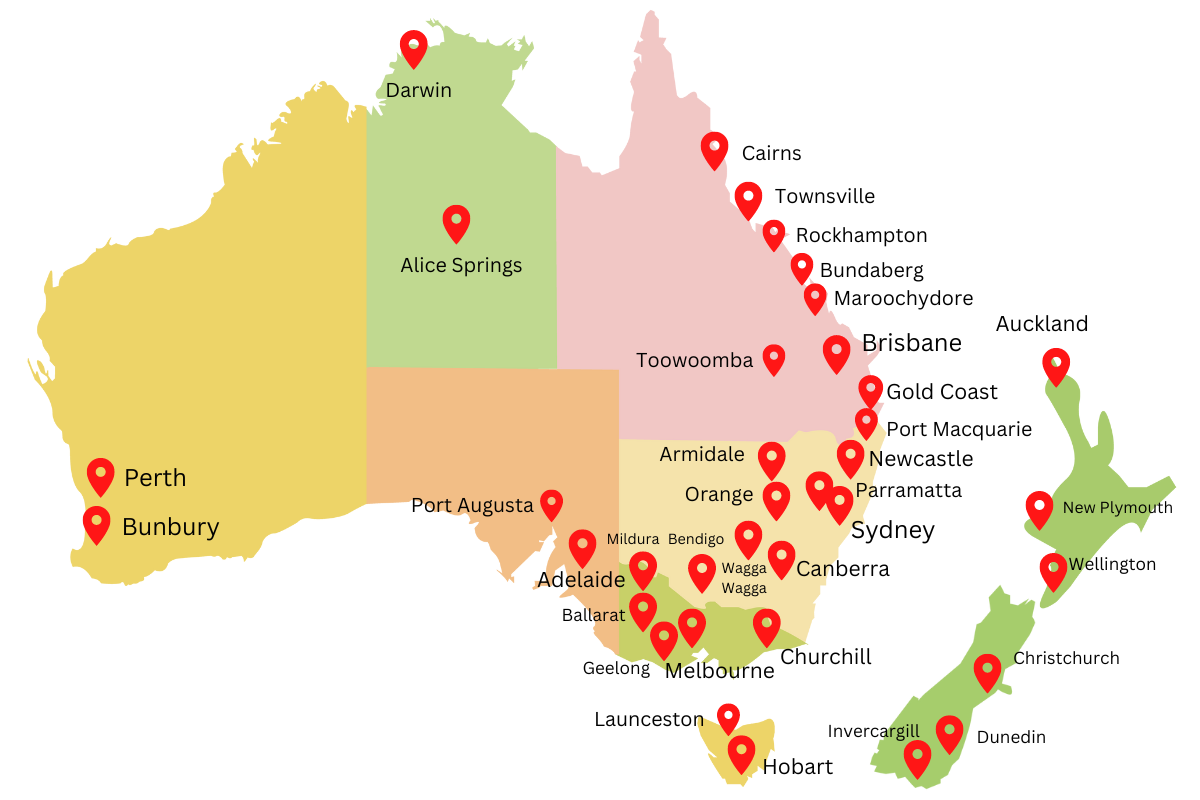
Australian test centres by state:
Please move to desktop to view the entire table without additional taps.
| State/Territory State/Territory |
Locations Locations |
|---|---|
| ACT ACT |
Canberra Canberra |
| NSW NSW |
7 test centres Armidale, Newcastle, Orange, Parramatta, Port Macquarie, Sydney, Wagga Wagga |
| NT NT |
Alice Springs, Darwin Alice Springs, Darwin |
| QLD QLD |
8 test centres Brisbane, Bundaberg, Cairns, Gold Coast, Maroochydore, Rockhampton, Toowoomba, Townsville |
| SA SA |
Adelaide, Bordertown, Port Augusta Adelaide, Bordertown, Port Augusta |
| TAS TAS |
Hobart, Launceston Hobart, Launceston |
| VIC VIC |
6 test centres Ballarat, Bendigo, Churchill (near Traralgon), Geelong, Melbourne, Mildura |
| WA WA |
Bunbury, Geraldton, Perth Bunbury, Geraldton, Perth |
New Zealand: Auckland, Christchurch, Dunedin, Invercargill, New Plymouth, Wellington.
Overseas: The UCAT ® can also be sat at Pearson VUE centres worldwide, including Hong Kong, Singapore, the UK, and the USA. The overseas test fee is $405 AUD.
Most capital city centres offer test dates throughout the entire five-week testing window, but regional centres may only offer one or two dates. Book early — popular metropolitan centres fill up fast, and once they're full, you may need to travel further.
If you have a documented disability, medical condition, or special educational need and currently receive exam accommodations at school or university, you may be eligible for access arrangements when sitting the UCAT ® 2026.
Available accommodations include:
25% extra time (with or without rest breaks)
10 minutes extra per hour (with or without rest breaks)
Rest breaks only (standard test time + 20 minutes of break time)
Separate room or small group testing
Wheelchair access
Adjustable font size and colour scheme
Access to medically necessary food, drink, or medical items at your workstation
Application timeline:
Opens: 16 February 2026
Standard deadline: 15 May 2026 (standard test fee)
Late deadline: 29 May 2026 (+ $85 late fee)
Access arrangements must be approved before an adjusted appointment is finalised. Pearson handles bookings for approved access-arrangement candidates. Two supporting documents are required: a letter from your school confirming your current exam accommodations, and the underlying documentation from a registered health practitioner or psychologist.
Important: Access arrangements are approval-led. If you already booked a standard test, submit your application by the published deadline and follow official UCAT ® ANZ instructions. Do not assume your existing appointment includes adjustments until Pearson confirms the approved arrangement.
Life happens — here's what you need to know about changing or cancelling your UCAT ® 2026 booking:
Free rescheduling: Before 29 June 2026 (11:59 pm AEST), you can reschedule at no cost.
Paid rescheduling: After 29 June, a $25 fee applies. You can reschedule up to 24 hours before your appointment.
Cancellation for refund: Cancel by 12 June 2026 for a refund (minus $50). Late fees are non-refundable.
Missed appointment: If you miss your test for any reason (illness, transport, wrong ID), there is no refund. You must rebook at full cost, subject to availability.
Cross-country rescheduling: You cannot reschedule to a different country through your Pearson account — your test must be cancelled and rebooked. Contact the UCAT ® ANZ Office for assistance.
The bottom line: if something goes wrong, it's always better to reschedule (even at a cost) than to risk a no-show with no refund.
Knowing what test day looks like removes a layer of stress. Here's the chronological walkthrough:
Fitness to Test policy: By attending your test, you are declaring yourself fit to sit it. If you're unwell on the day, the UCAT ® Consortium will not consider this as mitigating circumstances. If you're not feeling well, reschedule — even if it means paying the rescheduling fee.
The UCAT ® provides several on-screen tools. Knowing how they work before test day saves valuable seconds:
On-screen calculator: Available for Decision Making and Quantitative Reasoning only (not VR or SJ). It's a simple calculator — no scientific functions. Click the calculator button or press Alt + C to open it. Use your mouse or keyboard for input. The Backspace key clears all digits at once (there's no single-digit delete). Practice with it using the official practice tests — it behaves slightly differently from a physical calculator.
Laminated notebook and marker pen: This replaces paper for workings. It's A4 with several laminated pages and is not erasable. If your pen dries out or you run out of space, raise your hand for a replacement. Replace the cap when not in use.
Question flagging: Flag questions you want to revisit using the Flag for Review button (or Alt + F). At the end of each subtest, if you have time remaining, you'll see a review screen showing flagged and incomplete questions. Use the Navigator (Alt + V) to jump directly to any question within the current subtest.
Keyboard shortcuts: Alt + N (next question), Alt + P (previous), Alt + V (navigator), Alt + C (calculator). You can also select answers by pressing the corresponding letter key (e.g B for option B).
These are the most common — and most preventable — mistakes that cost UCAT ® candidates:
The UCAT ® uses scaled scoring, which means your raw marks are converted to a standard scale so that scores are comparable across different test dates and question sets. There is no negative marking — unanswered questions simply score zero, so always guess if you're running out of time.
Please move to desktop to view the entire table without additional taps.
| Subtest Subtest |
Questions Questions |
Marking Marking |
Scale Score Scale Score |
|---|---|---|---|
| Verbal Reasoning Verbal Reasoning |
44 44 |
1 mark per question 1 mark per question |
300–900 300–900 |
| Decision Making Decision Making |
35 35 |
Single-answer: 1 mark. Multi-statement: up to 2 marks (partial marks for partially correct) Single-answer: 1 mark. Multi-statement: up to 2 marks (partial marks for partially correct) |
300–900 300–900 |
| Quantitative Reasoning Quantitative Reasoning |
36 36 |
1 mark per question 1 mark per question |
300–900 300–900 |
| Total Cognitive Score Total Cognitive Score
| VR + DM + QR VR + DM + QR
| 900–2,700 900–2,700
| |
| Situational Judgement Situational Judgement |
69 69 |
Full marks for correct; partial marks for close to correct Full marks for correct; partial marks for close to correct |
300–900 (separate) 300–900 (separate) |
For reference, the 2025 UCAT ® ANZ mean scores were: VR 620, DM 642, QR 679, Total Cognitive Score 1,941, and SJ 586, across 16,950 candidates.
Your total cognitive score (VR + DM + QR, ranging from 900 to 2,700) and your Situational Judgement score (300 to 900) are reported separately because they measure fundamentally different things.
The cognitive score assesses your reasoning abilities — the intellectual aptitude universities want in their students. The SJ score assesses your professional judgement and interpersonal skills — how you'd handle real-world clinical and ethical scenarios.
Universities treat these scores differently. Some use the total cognitive score as a ranking tool, some apply it as a threshold (minimum score to be considered), and some use a weighted composite with your ATAR and interview. Not all universities use the SJ score, but those that do (including Adelaide, UQ, Auckland, and Otago) may use it as an additional hurdle or factor.
For a deeper analysis of what constitutes a competitive score, including percentile breakdowns and university-specific benchmarks, see our detailed UCAT ® scores page .
UCAT ® 2026 results are valid for one admissions cycle only. If you sit the UCAT ® in 2026, those results can only be used to apply for university entry in 2027. Results cannot be carried over to future years.
This is a significant difference from the GAMSAT ®, where results remain valid for four years. The one-year validity of the UCAT ® means you need to sit the test in the year before you want to start university — there's no "banking" a good score for later.
If your university application is unsuccessful for 2027 entry, or you choose to defer and reapply, you'll need to sit the UCAT ® again in 2027.
There's no single "pass mark" for the UCAT ®. Each of the 18 consortium universities uses UCAT ® scores differently within their admissions process. Understanding how your target universities weight the UCAT ® is essential for setting realistic score goals.
The three main models are:
Most universities use UCAT ® performance as the primary basis for interview invitations, with the final offer then determined by a combination of interview, UCAT ®, and academic results.
Always check individual Australian medical school websites for their current selection criteria, as these can change from year to year.
Sixteen Australian and two New Zealand universities require (or accept) UCAT ® scores for their medical, dental, and clinical science programs. Here is the full list for 2027 entry:
Australia:
Please move to desktop to view the entire table without additional taps.
| University University |
State State |
Program(s) Program(s) |
UCAT Usage UCAT Usage |
|---|---|---|---|
| Adelaide University Adelaide University |
SA SA |
Medicine, Dental Surgery, Oral Health Medicine, Dental Surgery, Oral Health |
Compulsory Compulsory |
| Central Queensland University Central Queensland University |
QLD QLD |
Medical Science (Regional Medical Pathway → UQ) Medical Science (Regional Medical Pathway → UQ) |
Compulsory Compulsory |
| Charles Sturt University Charles Sturt University |
NSW NSW |
Dental Science, Medicine Dental Science, Medicine |
Compulsory Compulsory |
| Curtin University Curtin University |
WA WA |
Medicine Medicine |
Compulsory Compulsory |
| Flinders University Flinders University |
SA SA |
Clinical Sciences / Medicine Clinical Sciences / Medicine |
Compulsory Compulsory |
| Griffith University Griffith University |
QLD QLD |
Dental Health Science (compulsory), Medical Science (optional) Dental Health Science (compulsory), Medical Science (optional) |
Varies Varies |
| Monash University Monash University |
VIC VIC |
Medicine Medicine |
Compulsory Compulsory |
| University of Newcastle / University of New England University of Newcastle / University of New England |
NSW NSW |
Joint Medical Program Joint Medical Program |
Compulsory Compulsory |
| University of New South Wales University of New South Wales |
NSW NSW |
Medicine Medicine |
Compulsory Compulsory |
| University of Notre Dame Australia University of Notre Dame Australia |
WA/NSW WA/NSW |
Medicine Pathway Medicine Pathway |
Compulsory Compulsory |
| University of Queensland University of Queensland |
QLD QLD |
Medicine (provisional entry pathway), Dental Science Medicine (provisional entry pathway), Dental Science |
Compulsory Compulsory |
| University of Southern Queensland University of Southern Queensland |
QLD QLD |
Medicine Pathway (provisional entry → UQ MD) Medicine Pathway (provisional entry → UQ MD) |
Compulsory Compulsory |
| University of the Sunshine Coast University of the Sunshine Coast |
QLD QLD |
Medical Science (optional, provisional entry → Griffith MD) Medical Science (optional, provisional entry → Griffith MD) |
Optional Optional |
| University of Tasmania University of Tasmania |
TAS TAS |
Medicine Medicine |
Compulsory Compulsory |
| University of Western Australia University of Western Australia |
WA WA |
Doctor of Medicine, Doctor of Dental Medicine (via Bachelor of Biomedicine) Doctor of Medicine, Doctor of Dental Medicine (via Bachelor of Biomedicine) |
Compulsory Compulsory |
| Western Sydney University Western Sydney University |
NSW NSW |
Medicine Medicine |
Compulsory Compulsory |
New Zealand:
Please move to desktop to view the entire table without additional taps.
| University University |
Program Program |
|---|---|
| University of Auckland University of Auckland |
Medicine Medicine |
| University of Otago University of Otago |
Medicine Medicine |
Note the regional pathway programs: CQU's Medical Science leads into UQ Medicine, USQ's pathway also feeds into the UQ MD (Darling Downs–South West Medical Pathway), and USC's optional pathway leads to Griffith's MD. These can be excellent options for students interested in studying UCAT ® medicine through a regional route.
If you're considering dentistry programs specifically, our UCAT ® dentistry page covers which universities require the UCAT ® for dental entry and how scores are used.
For 2026 logistics, the short answer is pathway-based: the UCAT ® is the undergraduate aptitude test (about two hours, one sitting per year, results valid for one admissions cycle, standard ANZ fee $335), while the GAMSAT ® is the graduate-entry exam (about 5.5 hours, two sittings per year, results valid for up to four years, standard fee $568). If you're in Year 12 aiming at undergraduate medicine or dentistry, plan around UCAT ® 2026 dates above. If you're applying to graduate-entry programmes, use GAMSAT ® 2026 instead.
For the full side-by-side comparison — format, scoring, cost, and which students suit which pathway — see UCAT ® vs GAMSAT ® and our overview of how to become a doctor .
Most students begin focused UCAT ® preparation two to four months before their test date — typically March to May 2026 for a July sitting. The "right" window depends on your baseline and how much time you can dedicate alongside school. Align prep to the UCAT ® 2026 cycle rather than waiting until bookings open.
Here's a practical 2026 timeline:
March–April 2026: Familiarise yourself with the test format, question types, and timing. Take a diagnostic practice test to identify baseline strengths and weaknesses. Official UCAT ® ANZ practice tests and question banks are usually refreshed with new questions in early March each year — around the same time UCAT booking opens.
April–May 2026: Begin structured practice, focusing on weaker subtests. Build speed reading and mental arithmetic — even 10 minutes a day of deliberate practice compounds. Work through the official Question Tutorials before moving to timed sets, and lock in your preferred test centre before standard booking closes on 15 May 2026.
May–June 2026: Shift to timed practice under exam conditions. Complete full-length practice tests to build stamina and refine time management. Learn when to skip and flag questions — not every question deserves your time.
Late June into the testing window: Final revision and light practice before your booked date (1 July – 5 August 2026). Consolidate strategies rather than cramming new material, and review common mistakes for each subtest.
The UCAT ® tests aptitude rather than curriculum knowledge, so "studying" looks different from exam revision. You're training yourself to process information faster and more accurately under time pressure — which takes consistent practice, not last-minute cramming.
For students and parents navigating the UCAT ® for the first time, our UCAT ® preparation guide covers how to start prep and how parents or guardians can support the process. For free practice starting points, see free UCAT ® preparation materials .
Ready to start preparing? Here are GradReady's guides and resources to support your UCAT ® 2026 journey:
Meaning, who needs UCAT ANZ, registration overview, and how the exam fits undergraduate applications.
Four subtests, question counts, subtest times, and scoring overview (900–2700 cognitive total).
Scaled totals (900–2700), percentiles, and what universities treat as competitive.
UCAT preparation strategy, study plan, timelines, and tips across all four current subtests.
Free practice and reading links to start without a paid course.
Question types, timing, and preparation tips for the first subtest.
Question types, timing, and preparation tips for the second subtest.
Numerical reasoning strategy, timing, and practice approach.
Scenario-based judgement questions and how SJT is scored separately (300–900).
Access free practice questions and preparation resources.
Find the right GradReady UCAT course for your needs.