25 min read | Read 453667 times
Free GAMSAT ® practice questions and tests should help you do two things: learn question style in small sets, then test timing and stamina in a realistic online practice test. This page brings those practice questions, MCQs, worked solutions, essay prompts, and full-test resources together in one place.
Below you’ll find free GAMSAT ® sample questions for every section: a Section 1 poetry comprehension MCQ, a Section 2 essay prompt set, and Section 3 biology, chemistry, and physics MCQs with fully worked solutions. You can then unlock 40 more MCQs from our Intelligent MCQ Bank and sit a full free GAMSAT ® practice test on GradReady’s ACER-like online exam platform.
Start with the free practice questions if you want worked examples, or use the GAMSAT ® Free Trial when you are ready for the MCQ bank and full practice test.
New to the exam? Pair these free GAMSAT ® practice questions and tests with how to prepare for the GAMSAT ® and the section guides linked below. For the broader free resource library, see Free GAMSAT ® Preparation Materials.

The best free GAMSAT ® practice questions and tests depend on what you need to learn next. Short sample questions are best for learning question style and seeing worked solutions; a larger MCQ bank is better for repeated subtopic practice; a full online GAMSAT ® practice test is best for diagnosing pacing, stamina, and exam-platform familiarity.
A simple sequence is: attempt a small set untimed, review every worked solution, repeat weak subtopics in the GAMSAT ® Free Trial MCQ bank, then sit a full free GAMSAT ® practice test once you are ready to measure timing and stamina.
For official context, ACER explains that GAMSAT ® assesses your ability to understand, analyse, reason, make logical deductions, and form judgements. That is why free GAMSAT ® practice questions are most useful when you review the reasoning process, not just the final answer.
Looking for free GAMSAT ® practice questions or sample MCQs? Work through the free GAMSAT ® practice questions below — one Section 1 poetry comprehension MCQ, one Section 2 prompt set, and biology, chemistry, and physics questions for Section 3. Answers and worked solutions follow later on this page.
The following is a poem titled A Bird Came Down The Walk by Emily Dickinson.
A bird came down the walk:
He did not know I saw;
He bit an angle-worm in halves
And ate the fellow, raw.
And then he drank a dew
From a convenient grass,
And then hopped sidewise to the wall
To let a beetle pass.
He glanced with rapid eyes
That hurried all abroad,
They looked like frightened beads, I thought;
He stirred his velvet head
Like one in danger; cautious,
I offered him a crumb,
And he unrolled his feathers
And rowed him softer home
Than oars divide the ocean,
Too silver for a seam,
Or butterflies, off banks of noon,
Leap, splashless, as they swim.
1. What theme is most evident in A Bird Came Down The Walk?
2. In the final two stanzas, the bird is described as flying away. The depiction that the bird's flight "rowed him softer..." than oars dividing the ocean implies:
You can find more free GAMSAT ® Essay Topics and a Free GAMSAT ® Essay Quote Generator at our guide here: GAMSAT ® Section 2 Essays: How to Prepare
You can find some free example essays here: Free GAMSAT ® Example Essay
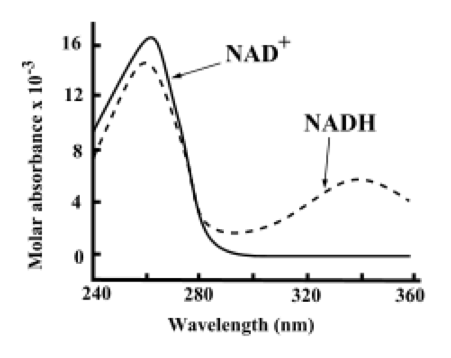
The diagram above shows the absorbance of NAD+ and NADH at various wavelengths of light. As NAD+ is a dinucleotide it absorbs, like all nucleotides, strongly in the 260-280 nm range. It can also be seen that the protonated form exhibits a modified absorbance spectra.
An important biochemical measure of the health of a cell is known as the redox state and is the ratio of NAD+ to NADH. A healthy cell has a redox state of around 700. This high ratio makes oxidative reactions favourable and thus enables oxidative phosphorylation, or the aerobic formation of ATP.
To do this, reference samples of known concentrations of NAD+ and NADH are made up and measured in a spectrophotometer. The unknown samples are then measured and compared to the reference samples to determine the quantity of NAD+ or NADH in the sample.
A molecular biologist has a number of samples that they wish to test the redox state of. For each question select the correct answer using the knowledge provided in this section
1. What wavelength would be most appropriate for determining the concentration of NAD + ?
2. What wavelength would be most appropriate for determining the concentration of NADH when discriminating against NAD + concentration?
3. What redox state would most likely be found in a cell that was overwhelmed with the work of metabolizing alcohol?
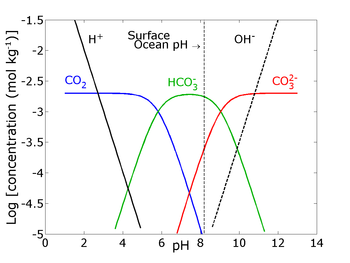
The increased emission of carbon dioxide into the atmosphere leads to a decrease in the pH of ocean water due to a chemical equilibrium between carbon dioxide (CO 2 ) and carbonic acid (H 2 CO 3 ) which can then contribute protons into the ocean:
CO 2 + H 2 O ↔ H 2 CO 3
H 2 CO 3 ↔ H + + HCO 3 -
HCO 3 - ↔ H + + CO 3 2-
The relative abundance of the above species at a given pH is represented on a Bjerrum Plot.
1. In 1751 the ocean pH was 8.25, but it is expected by 2100 that [H+] in the ocean will increase by 2.5 fold. Which of the following indicates the expected ocean pH in 2100?
2. The initial [H + ] in 1751 was 5.62 * 10 -9 M, and Ca(OH) 2 is a strong base that is expected to dissociate completely. How much Ca(OH) 2 (1.0 M) would be required to return a 4 L water sample from the year 2100 back to the acidities of year 1751?
3. Oceanic species such as corals and plankton have calcium carbonate (CaCO 3 ) skeletal structures that require the levels of CO 3 2- to be saturated in ocean waters. What effect would an increase in CO 2 emissions have on these species?
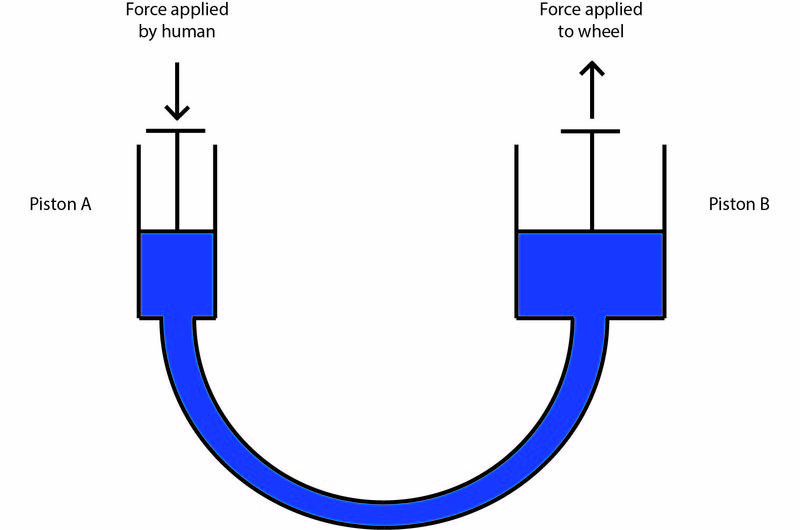
Hydraulic force multiplication is one of the mechanisms that allow the force applied to a car’s brake pedal by a person's foot to be multiplied to a level that can stop a car quickly. A very simplified diagram is provided below.
Piston A and B are both cylindrical and are at the same height. The fluid used, in blue, is water. The diameter of Piston A is 10 cm.
1. How much pressure would the person be applying to the water if they push down on the brake pedal with 200 N of force?
2. It is known that a fluid’s density increases as temperature increases and decreases as the temperature decreases. If the efficiency of the hydraulic braking system is defined as how effectively the forces are multiplied, what happens to the braking system efficiency on a hot day?
If you find the practice MCQs above useful, make sure you sign up for our GAMSAT ® Free Trial which includes 40 free MCQs from our Intelligent MCQ Bank. You will also get access to a GAMSAT ® practice test which mimics the official ACER GAMSAT ® exam in detail, allowing you to familiarise yourself with the online delivery of the exam before test date. Free Trial enrolment also unlocks Study Buddy matching — enlist in your dashboard and message other students preparing for the same exam.
The value of free GAMSAT ® practice questions comes from the review. After each answer, use the worked solution to reconstruct the reasoning path: what information in the stem mattered, which answer option matched it, and why the other options were tempting but wrong.
Re-solve before reading the solution. If you were unsure, write down the exact line, graph feature, equation, or assumption that made you hesitate.
Match the answer to evidence in the stimulus. Good GAMSAT ® MCQ review links every correct option back to the passage, data table, diagram, or scientific relationship supplied in the question.
Classify the mistake. Label errors as content knowledge, graph interpretation, reading precision, calculation setup, answer-option comparison, or timing. This turns sample questions into a targeted study plan.
Choose the next practice action. Revisit the relevant Section 1, Section 2, or Section 3 guide, then try another MCQ bank set or a timed practice test once the pattern is clearer.
Keep a short error log as you review the worked solutions below. A useful log records the section, topic, clue missed, reason the distractor was wrong, and one follow-up action. That gives your later GAMSAT ® practice tests a clear purpose instead of becoming another raw score.
1. C is correct.
Dickinson repeatedly compares and contrasts the cruelty/fear ("...bit an angle-worm in halves" depicting the predator-prey relationship between bird and worm) and beauty ("...he unrolled his feathers, And rowed him softer home") of nature. Students may interpret the poem to represent the other themes, however these are either not suggested (Answers 1 and 2) or a minor theme (Answer 4).
2. A is correct.
As the comparative 'softer' is used, it suggests that the natural sight of a bird flying is more beautiful than boat oars that create gentle ripples in the water. This implies natural beauty surpasses man-made beauty, as oars and boats are man-made. Use of enjambment (the continuation of a sentence without a pause beyond the end of a line, couplet, or stanza) creates a relaxed tone.
1. B is correct.
260nm is the answer as this is in the range light is most strongly absorbed by NAD + , which assists its measurement by a spectrophotometer
2. C is correct.
At 340nm, there is the greatest amount of difference between the standard molar absorbance of NAD + and NADH, and this would be the most appropriate point to measure the two comparatively.
3. B is correct.
In the stem, it is indicated that ' a healthy cell has a redox state of around 700. This high ratio makes oxidative reactions favourable and thus enables oxidative phosphorylation, or the aerobic formation of ATP '.
We can infer that a cell overwhelmed with the work of metabolizing alcohol is less healthy, and therefore the ratio would be less than 700.
The enzymes used to metabolise ethanol (ADH and ALDH2) reduce NAD + to NADH, and therefore the cellular NAD + / NADH redox ratio is lowered as a consequence of ethanol metabolism.
1. B is correct.
Students should be familiar with pH being a logarithmic scale with a change in 1 pH unit corresponding to a [H+] change of a factor of 10. Therefore, for an acidification with a [H+] factor change of 2.5 the pH is expected to decrease, but by less than 1 pH unit. The only answer that fulfills this criteria is B.
2. B is correct.
Calculate difference in proton concentration by determining concentration in 2100 and taking away initial concentration.
In 1751: [H + ] = 5.62 * 10 -9 M (mol L -1 )
Multiply by 2.5 to get 2100 levels: [H + ] = 14.1 * 10 -9 mol L -1
Difference in [H + ] (2100 levels - 1751 levels) = 8.48 * 10 -9 mol L -1
Determine amount of H + to be neutralised in a 4 L sample (multiply difference by 4 L):
4 L sample = 33.9 * 10 -9 mol to be neutralised
Each Ca(OH) 2 provides two hydroxides, therefore we require half this amount of Ca(OH) 2 :
n(Ca(OH) 2 ) = 17.0 * 10 -9 mol
Concentration is 1.0 M (mol L -1 ), therefore answer is 17.0 nanolitres (17.0 * 10 -9 L).
3. A is correct.
Of the extra carbon dioxide added into the oceans, some remains as dissolved carbon dioxide, while the rest contributes towards making additional carbonic acid and additional bicarbonate as in the equilibria. This also increases the concentration of hydrogen ions, and the percentage increase in hydrogen is larger than the percentage increase in bicarbonate, creating an imbalance in the reaction HCO 3 − ↔ CO 3 2− + H + . To maintain chemical equilibrium, some of the carbonate ions already in the ocean combine with some of the hydrogen ions to make further bicarbonate. Thus the ocean's concentration of carbonate ions is reduced, creating an imbalance in the reaction Ca 2+ + CO 3 2- ↔ CaCO 3 , and making the dissolution of formed CaCO 3 structures more likely. In other words, the CO32- concentration drops, so that the ocean is no longer saturated and CO 3 2- dissolves from the coral. This can be seen on the Bjerrum plot - as pH drops, the concentration of CO 3 2- drops too.
1. D is correct.
Using the formula P=F/A and keeping in mind that the radius of Piston A is 5 cm ,
p = 200 / (π x 5^2) N/cm^2
= 200 / (π x 25) N/cm^2
= 8 / π N/cm^2
= 8 / π N/(1/100m)^2
= 8 / π x 100^2 N/m^2
= 8 / π x 10^4 Pa
= 80 / π kPa
Remember that Pa (pascals) is the equivalent of N/m 2
2. D is correct.
On a hot day, the density of the water increases. Using the formula P = ρ X g X h it is clear that if the density (ρ) increases, then the pressure will increase.
However, this pressure increase is applied to both pistons. While this might increase the force applied to the water in Piston A, it increases the force applied to Piston B by the same proportion. In other words, the ratio of forces between the pistons remains the same, so the brake efficiency remains the same.
Once you’ve worked these free GAMSAT ® sample questions, sign up for the GAMSAT ® Free Trial for 40 more free MCQs from our Intelligent MCQ Bank — a larger free practice question set with worked solutions, difficulty filters, and performance tracking across 43 subtopics.
The full Intelligent MCQ Bank contains 8000+ GAMSAT ®-style practice questions. Build custom sets by subtopic and difficulty so you can focus practice questions on weak areas instead of revisiting topics you already handle well.
Free Trial access also includes GradReady’s online exam system — an ACER-like platform for a full free GAMSAT ® practice test with timing modes, worked solutions, and percentile reporting. The question bank is proprietary and mobile-friendly, so you can practise wherever you study.
Section 1: GAMSAT ® Reasoning in Humanities and Social Sciences is comprised of solely multiple-choice questions, and focuses mostly on the candidate’s ability to interpret and understand various ideas which may arise from different social and cultural contexts. There will be a number of modalities presented here ranging from argumentative writings and academic essays, to poems and fictional stories. Visual stimuli will also be included, such as satirical newspaper cartoons. Emphasised through these stems will be the need for candidates to understand both explicit and implicit nuances, employ rationalisation to come to various conclusions, and make discriminations and judgements.
Section 2: GAMSAT ® Written Communication will assess the candidate’s ability to generate and develop ideas in writing. Each of the two tasks currently offers four statements on a common theme; you write one essay per task. Of particular importance here is the candidate’s ability to clearly articulate their thoughts, whilst offering a thoughtful response to the theme, which often relates to socio-cultural or personal and social issues.
Section 3: GAMSAT ® Reasoning in Biological and Physical Sciences will include questions which cover a range of disciplines within science; namely, Chemistry, Biology and Physics. Chemistry will comprise 40% of the total Section III paper; Biology 40%, and Physics 20%. The expected standard of both Biology and Chemistry is to a first-year university level, whereas the expected standard for Physics is Year 12. This section focuses heavily on problem solving and will present graphs, tables and diagrams to the candidate for interpretation.
Section 2: Written Communication is on a different day than the other two sections of the GAMSAT ®. Each task currently offers four statements on a common theme; you write two essays in 65 minutes (about 30 minutes per task). GAMSAT ® Section 1 and 3 will occur around 3 weeks after the Written Communication section. There will be 62 multiple-choice questions (MCQs) in total for Section 1: Reasoning in Humanities and Social Sciences, which are to be completed within 100 minutes of test time. Lastly, Section 3: Reasoning in Biological and Physical Sciences will consist of 75 MCQs with a time limit of 150 minutes for all questions. All MCQs in Sections I and III will have 4 options to choose from.
There is no magic number of free GAMSAT ® practice questions that guarantees a competitive score — strengths, starting level, and how carefully you review each attempt matter more than raw volume.
As a practical benchmark: review every set of practice questions thoroughly (why the right option is right and why the others fail), aim for about one full GAMSAT ® practice test per week once you’re past the introductory sample stage, and write at least two full essays per week. That mix improves exam results more reliably than long untimed sessions without review.
Closer to test day, shift from untimed practice questions to timed sets and full practice tests so pacing matches ACER conditions.
Looking for a free GAMSAT ® practice test you can sit online under realistic exam conditions? A practice test goes beyond individual sample questions — it simulates the ACER GAMSAT ® with full Section 1 and Section 3 MCQ volumes, timing options, and an exam-style interface so you can diagnose strengths, pacing, and platform familiarity before test day.
Our free GAMSAT ® practice test gives you 62 Section 1 and 75 Section 3 questions across a range of topics and difficulties, delivered on GradReady’s online exam platform designed to closely mimic the official ACER GAMSAT ®. You can sit it under real time pressure or at your own pace, then review worked solutions and percentile comparison against other GradReady students.
Sign up for our Free Trial to unlock this GAMSAT ® practice test plus other free preparation resources. Prefer to try a few sample items first? Start with the free GAMSAT ® practice questions above, then return here for a full practice exam.
Watch the video below to see our online exam system in action — and how this free online GAMSAT ® practice test mirrors the official ACER platform.
A GAMSAT ® practice test is a structured, exam-style set of multiple-choice questions that mirrors the reasoning demands of the official ACER GAMSAT ®. GradReady’s online practice test challenges critical thinking, problem-solving, and the ability to apply what you have learned — across GAMSAT ® Section 1 (Reasoning in Humanities and Social Sciences) and Section 3 (Reasoning in Biological and Physical Sciences).
What sets this free online GAMSAT ® practice test apart is a user interface carefully designed to simulate the look and feel of the actual exam. Familiarising yourself with the platform ahead of time reduces stress on ACER test day and lets you focus on improving your GAMSAT ® score. See our guide on what the GAMSAT ® exam covers for the official format and structure.
If you enrol in a GAMSAT ® Preparation Course, you get access to up to 15 online exams with worked solutions, available in multiple modes so you can practise at your own pace or under real time pressure.
Otherwise, sign up to the GAMSAT ® Free Trial for a free practice test with 62 Section 1 MCQs and 75 Section 3 MCQs — matching official section lengths.
A GAMSAT ® practice exam is the fastest way to diagnose strengths and weaknesses before you invest weeks in unfocused study — especially if your goal is an Australian medical school.
The most efficient study approach is to spend the majority of time on areas that need improvement. After taking our free GAMSAT ® practice test, you can review a performance breakdown and identify strong and weak subtopics. The system also compares your score to 12,000+ other GradReady students so you know where you stand.
For target scores and cut-offs, read our guide to medical school admission requirements.
GAMSAT ® Mock Exams are included in our GAMSAT ® Attendance Courses. They are the closest simulation to the real sitting: timed conditions, a well-simulated environment, video solutions, personalised Section 2 essay feedback within a week, and an online recap day with our tuition team.
A GAMSAT ® practice test is an online Section 1 and Section 3 exam focused on high-value sub-topics, sat on our ACER-like platform. The free practice test in the Free Trial contains 62 Section 1 MCQs and 75 Section 3 MCQs.
Enrol in any GAMSAT ® Preparation Course for access to up to 15 practice exams, each with 62 Section 1 and 75 Section 3 MCQs — matching the official GAMSAT ® lengths.
Whether you start with the Free Trial or a Preparation Course, you use the same GradReady online exam platform that mimics the official ACER GAMSAT ®. You can sit exams in Mock Exam Mode or Custom Mode — explained in the section below.
There are no freely downloadable official GAMSAT ® past papers. ACER produces the only official preparation materials — e-book practice tests and online interactive practice tests for all sections — sold through an ACER account on the official ACER GAMSAT ® preparation page (you do not need to be registered for a sitting to purchase them). Practice Test A is included with GAMSAT ® registration; Practice Tests A and B are full-length Humanities and Biological & Physical Sciences papers (about 4 hours 10 minutes under exam conditions), with answers provided.
ACER’s online interactive practice tests run inside a replica of the test application with inbuilt timers (62 questions / 100 minutes for Humanities; 75 questions / 150 minutes for Biological & Physical Sciences). ACER also provides a platform demo for interface familiarisation; demo questions are from the Practice Questions publication and are not marked.
GradReady’s free GAMSAT ® practice test is a third-party exam simulation: ACER-like interface, full Section 1 and Section 3 volumes, worked solutions, and performance analytics. Use official ACER materials for authenticity, and use additional free online practice tests — like this one — for volume, timing practice, and platform familiarity. For short sample items with explanations before sitting a full test, use the free GAMSAT ® practice questions on this page.
This split matters: ACER practice material is the benchmark for official item style, while GradReady’s free GAMSAT ® practice questions and tests add worked solutions, subtopic tracking, percentile comparison, and extra repetition. Using both gives you authenticity and feedback.
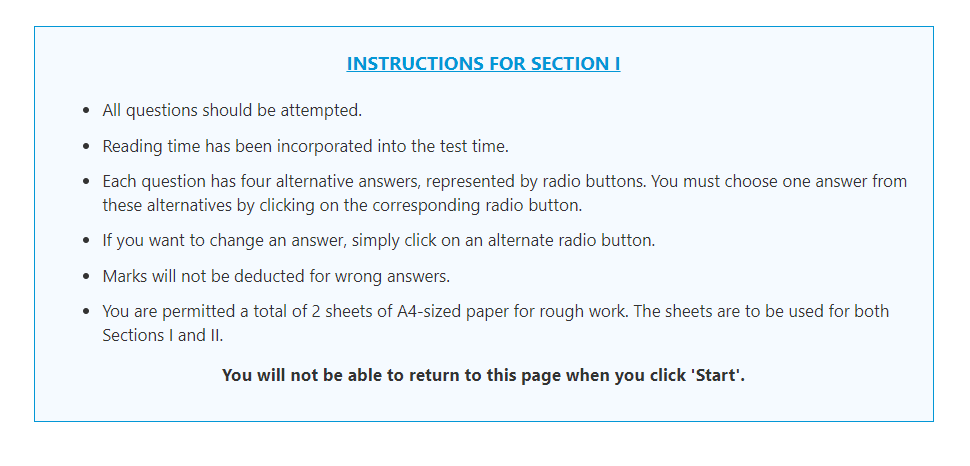
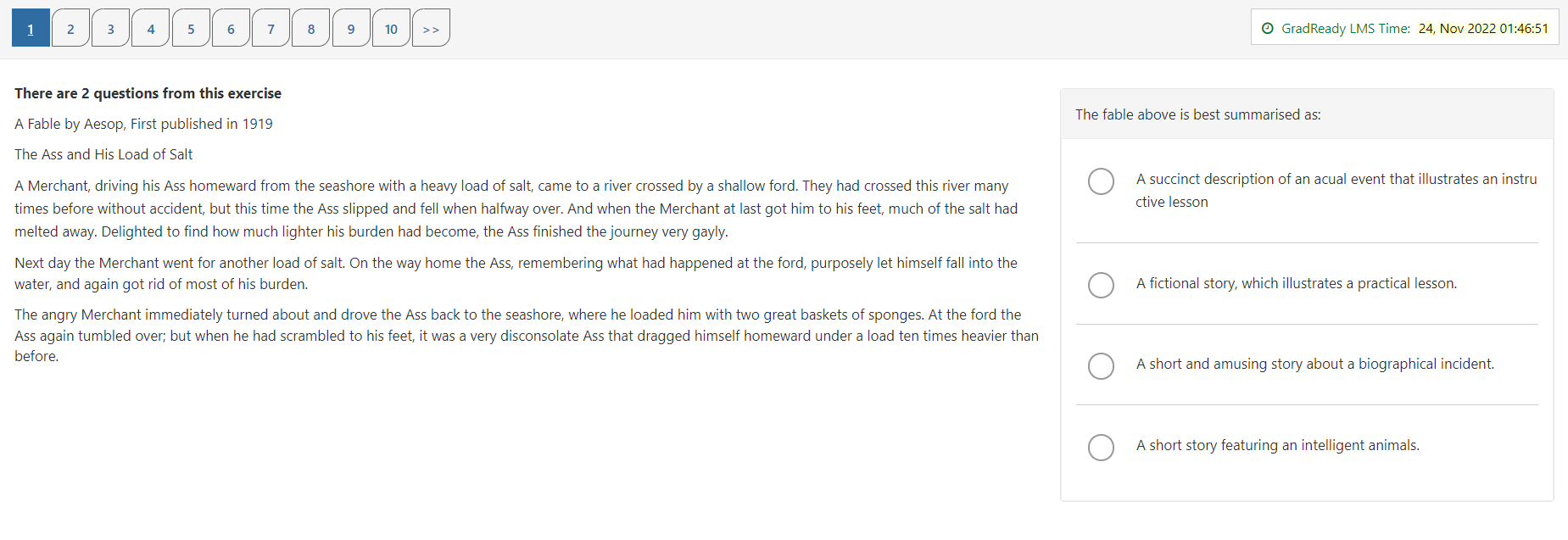
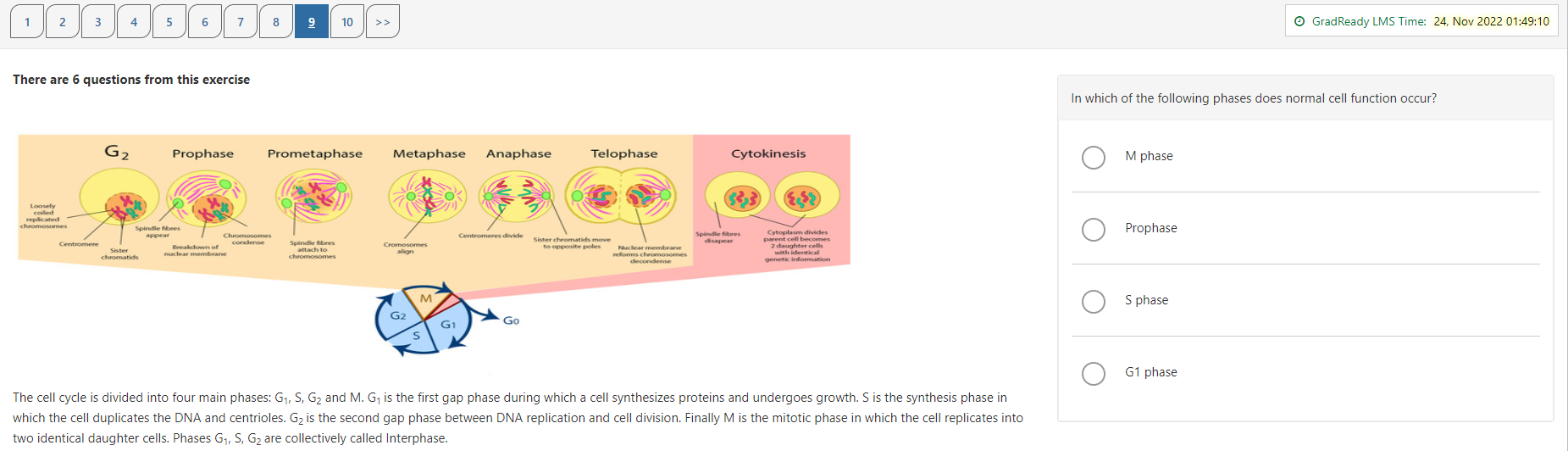
When you begin the exam, an introduction page gives instructions that closely match the official GAMSAT ®. The Section 1 and Section 3 interface also closely mimics the official ACER GAMSAT ® platform, so you can familiarise yourself with online delivery before test day and better prepare for the GAMSAT ®.
Watch the video above to see the online exam system in action and how this free GAMSAT ® practice test mirrors the official exam.
You can choose between the Mock Exam Mode and the Custom Exam Mode. The Mock Exam Mode will simulate the full GAMSAT ® exam experience in which you have to complete the exam within one sitting with the associated time pressures and the appropriate spacing between sections.
The Custom Exam Mode gives you various options to complete the exam at your own pace.
You can select the No Timer option which allows you to complete the exam in different settings. For example, you can complete Section 1 in one day and finish the remainder of the exam another day.
Selecting the Apply Time Limit to the Entire Exam option allows you to customise the length for each section of the exam. For example, you can choose to give yourself extra time to complete the exam compared to the official GAMSAT ® section timings.
Thirdly, you can choose to Apply Time Limit to Individual Questions. This is useful if you're trying to develop a good pace per question.
Some other useful features of the Custom Mode include the ability to select a specific section of the exam to complete as well as the option to skip reading time. These features are not available in Mock Exam Mode.
Make sure to sign up to our Free Trial to get access to our GAMSAT ® Practice Test as well as heaps of other free resources!
For GAMSAT ® Section 1 and Section 3, you will have access to the correct answers with the accompanying worked solutions. If you are enrolled in one of our GAMSAT ® Preparation Courses, you will also have access to relevant supplementary content and features on our website such as videos and textbook sections for each MCQ. You will not have access to these with a Free Trial account, but we also offer lots of Free GAMSAT ® Preparation Materials, such as our GAMSAT ® study syllabus and a GAMSAT ® essay guide, so be sure to check them out.
You will be able to review your percentiles in comparison to all other students who have completed the practice exam. You will also be able to review a breakdown of your performance and determine various points of strength and weakness. Compare your GAMSAT ® score to 12,000+ other GradReady students and get a better idea of where you stand!
For more information about what your GAMSAT ® score means, check out our comprehensive guide on GAMSAT ® results.
The Free GAMSAT ® Practice Test contains 62 Reasoning in Humanities and Social Sciences MCQs.
These questions require complex logical reasoning, and verbal processing to arrive at the answers. You’ll see a wide range of stimuli including cartoons, poems and longer texts, each of which is associated with 2 or more 4-option multiple-choice questions.
Visit our guide on how to prepare for GAMSAT ® Section 1 to improve your score.
Section 2 (Written Communication) is not included in our Free GAMSAT ® Practice Test. Section 2 is included in the 5 mock exams which are available to students who enrol in our GAMSAT ® Preparation Courses. You will receive two sets of essay prompts and will be able to write your responses.
If you'd like your essay to be reviewed and marked, we have a GAMSAT ® essay marking service where our expert tutors will provide personal feedback for your essays within 72 working hours.
On this page you can still practise Section 2 with the free essay prompt set, our quote generator, and our free GAMSAT ® example essays.
The Free GAMSAT ® Practice Test contains 75 Reasoning in Biological and Physical Sciences MCQs.
These questions focus mainly on your ability to analyse, interpret and generalise based on scientific data, equations and concepts. You will be provided with a wide range of stimuli including graphs, formulas, diagrams and text, again associated with MCQs.
Visit our guide on how to prepare for GAMSAT ® Section 3 to improve your score.
Once you decide to sit the ACER GAMSAT ®, the breadth of Section 1 and Section 3 topics can make it hard to know where to start.

A GAMSAT ® practice test gives you that direction. Under exam-style conditions you learn which question types you miss, how time pressure changes accuracy, and which subtopics deserve more study — so remaining GAMSAT ® preparation is targeted.
For example, you might struggle with poetry stems in Section 1, or find Physics reasoning weaker than Biology. The free online practice test feeds GradReady’s intelligent MCQ system, which tracks performance across 43 subtopics so strengths and weaknesses are visible after one sitting.
Practice tests also train your relationship with timing. Many candidates struggle with pace on ACER test day; timed and custom modes let you measure how long a set takes and how pressure affects accuracy before you dial in skip/guess strategies.
Once you’ve learned your way around this GAMSAT ® practice test platform, navigating ACER’s interface on exam day is far less unfamiliar — especially alongside the official demo and interactive practice tests described above.
Start with ACER’s official practice materials for authenticity — they contain genuine GAMSAT ®-style questions and, for the interactive online tests, a replica of the test application. Registration includes Practice Test A; additional ACER e-books and online practice tests can be purchased through an ACER account.
Official volume alone is rarely enough. Extra timed practice tests improve pacing, stamina, and confidence under exam conditions. GradReady’s free GAMSAT ® practice test complements ACER materials with an ACER-like interface, Mock Exam and Custom timing modes, worked solutions, and percentile comparison — so you can sit more full Section 1 and Section 3 papers before test day.
Remember how long you have on average for each MCQ! After all, each MCQ is worth the same on the day of the GAMSAT ®, but not all Qs are built the same. Knowing when to skip and come back later is a crucial skill to test out.
Skim Qs before reading the stimulus if you feel this will help. This enables you to see to what detail you need to read the passage or data at hand, and can make for more efficient appraisal of the stimuli.
Eliminate answer options! You can always rule out some options. Our podcast episode on Using Educated Guessing in the GAMSAT ® Exam discusses this in great detail, so be sure to check it out!
Stay calm! You’ve got this. You have built up tons of knowledge over the years. At the moment of any test your job is to apply it, and worry about what you can improve after the test.
Lastly, do what’s right for you. If you have strategies that work for MCQs, then implement them.
All in all, it's important to know what type of skills the GAMSAT ® actually wants to test. Visit our guide on What is the GAMSAT ® to learn all you need to know about this challenging exam.
Your practice test score is a scaled version of your raw marks (how many Section 1 and Section 3 questions you answered correctly). That scaling approach mirrors how ACER reports section scores for the official GAMSAT ® — so treat the result as a diagnostic signal, not a guaranteed sitting score.
See our article on GAMSAT ® scores for how section scores, overall scores, and percentiles work on the real exam.
The GAMSAT ® is a difficult, gruelling exam. It tests a wide variety of skills and is high stakes in nature given what it provides students down the line, which is a pathway to becoming a doctor. However, it is manageable!
Importantly, study and practice does improve scores on the GAMSAT ®. According to ACER, the GAMSAT ® exam tests critical thinking skills and your ability to analyse materials - all of which you learn and acquire either through education via schools or universities, self-study or studying through us! However, to know whether you are improving, practice tests are your best bet, and our GAMSAT ® Free Practice Test ensures you have a base level to quantify your progress.
There is no pass mark or rate for the GAMSAT ® exam. Medical schools in Australia usually want you to get over 50 on each of the 3 sections of the exam. And they then may rank you against other students using your overall score or your score on individual sections.
So get your GAMSAT ® prep started by signing up for our Free Trial to get access to our GAMSAT ® Practice Test as well as heaps of other free resources!
Use these guides alongside free practice questions — they explain how each section is assessed so your MCQ and essay practice stays purposeful.
The GAMSAT ® rewards reasoning and problem-solving more than content recall. After building foundations, prioritise applying knowledge through practice questions rather than re-reading notes alone.
Sit a full free online GAMSAT ® practice test with an ACER-like interface, timing modes, and worked solutions.
The most comprehensive library of free GAMSAT Preparation materials available.
Covers everything you need to know about your GAMSAT ® Results - How the scoring works, result release dates and even GAMSAT ® score cutoffs.
A breakdown of how to approach study effectively and how to set up a GAMSAT ® study schedule
An overview of what to expect in Section 1 of the GAMSAT ® Exam and how to prepare.
An overview of what to expect in Section 2 of the GAMSAT ® Exam, how to prepare and how to perfect your essay technique.
Marked Task A and Task B sample essays with tutor feedback, plus Section 2 essay topics.
An overview of what to expect in Section 3 of the GAMSAT ® Exam and how to prepare for each of the topics - Biology, Chemistry, & Physics.
Get even further details and specific tips for the Biology component of Section 3 of the GAMSAT ® Exam
Further advice and information specific to GAMSAT ® Section 3 Chemistry - Get a detailed breakdown of various topics.
Not sure about the value of preparing for GAMSAT ® Physics? Think again - The Physics component of Section 3 can be a key separator of student performance, get further details on how to prepare.
| Course | Key Features | Description |
|---|---|---|
| GradReady GAMSAT ® Online Courses | ||
| Starter | Foundational GAMSAT preparation resources | An affordable entry point into GAMSAT preparation, providing key foundational resources to help you begin your preparation journey. |
| Online (Essentials) |
8000+ Intelligent MCQ Bank
1200+ page Textbook 8 Online Practice Exams 2 Marked Essays with Personal Feedback 5 Mock Exams |
Designed for students who are unable to make our attendance classes, this course gives you the essentials to succeed. |
| Online (Comprehensive) |
8 Marked Essays with Personal Feedback
15 Online Practice Exams GetClarity: Tutor Assistance when you need it on whatever you need it on |
All the features of our Online (Essentials) Course plus more Marked Essays, Practice Exams, and on-demand Tutor Assistance with our GetClarity system |
| GradReady GAMSAT ® Attendance Courses | ||
| Attendance (Comprehensive) |
15 Day Course - 75+ hours of Learning
10 Marked Essays with Personal Feedback GetClarity: Tutor Assistance when you need it on whatever you need it on 5 Mock Exams and Subsequent Review Complimentary Additional Round of Virtual PBLs |
Our most popular course. Includes all the live classes as well as access to our Online (Comprehensive) resources |
| Attendance (Complete Care) |
15 Day Course - 75+ hours of Learning
15 x 1 hour Private Tutoring sessions 5 Mock Exams and Subsequent Review Complimentary Additional Round of Virtual PBLs |
Everything you need to succeed – includes private tutoring sessions in addition to the Attendance (Comprehensive) Package |
| Attendance (Success Assured) |
15 Day Course - 75+ hours of Learning
40 x 1 hour Private Tutoring sessions Personal GradReady Success Leader 5 Mock Exams and Subsequent Review 2 Complimentary Re-Enrolments (each valid for 1 year) Complimentary InterviewReady Course Enrolment |
Our most comprehensive course - valid for up to 3 years. You will be assigned a personal tutor (GradReady Success Leader) who will be supporting you throughout your journey |
To learn more about our GAMSAT ® Preparation courses and compare their different components, view an in depth comparison here: GradReady Course Comparison
If you’re after a single feature, such as our Textbook, or access to our 8000+ Intelligent MCQ Bank, or if you want to customise your preparation, you can do so here: GradReady GAMSAT ® Custom Course.
At GradReady, we pride ourselves on providing students with the Best Results at the Best Value:
To learn more about our courses and compare us to the competition, visit: GradReady GAMSAT ® Preparation Courses