20 min read | Read 191239 times
Effective GAMSAT ® preparation is less about cramming facts and more about training reasoning under time pressure. If you are searching for how to study for the GAMSAT ® , start here: the Graduate Medical School Admissions Test is designed to assess the capacity to undertake high-level intellectual studies in the medical and health professional programs by examining analytical thinking, written communication, and scientific problem-solving — not simple content recall. That means your GAMSAT prep should combine foundational knowledge, deliberate practice, feedback, and timed simulations.
ACER’s official GAMSAT ® preparation advice is that the exam measures skills built over time, so last-minute cramming has little benefit. Most candidates therefore treat this as a GAMSAT ® study strategy of 3–6 months: diagnose first, cover assumed knowledge, practise all three sections, then simulate the computer-based exam. Written Communication is sat in an earlier test window than Sections 1 and 3, so how to start GAMSAT ® preparation also means peaking essay practice before the first sitting.
In short, how to prepare for the GAMSAT ® usually follows this sequence:
The rest of this GAMSAT ® preparation guide expands those GAMSAT ® study tips with timelines, section balance, and practice progression. For dates and registration first, see GAMSAT ® 2026; for week-by-week calendars, use the GAMSAT ® study schedule; for topic checklists, use the GAMSAT ® study syllabus.

Not sure where to start your GAMSAT ® Preparation and feeling overwhelmed with all the information available? No worries! One of our expert tutors, Georgia, has summarised the contents of this page in this How to Prepare for the GAMSAT ® Exam video guide.
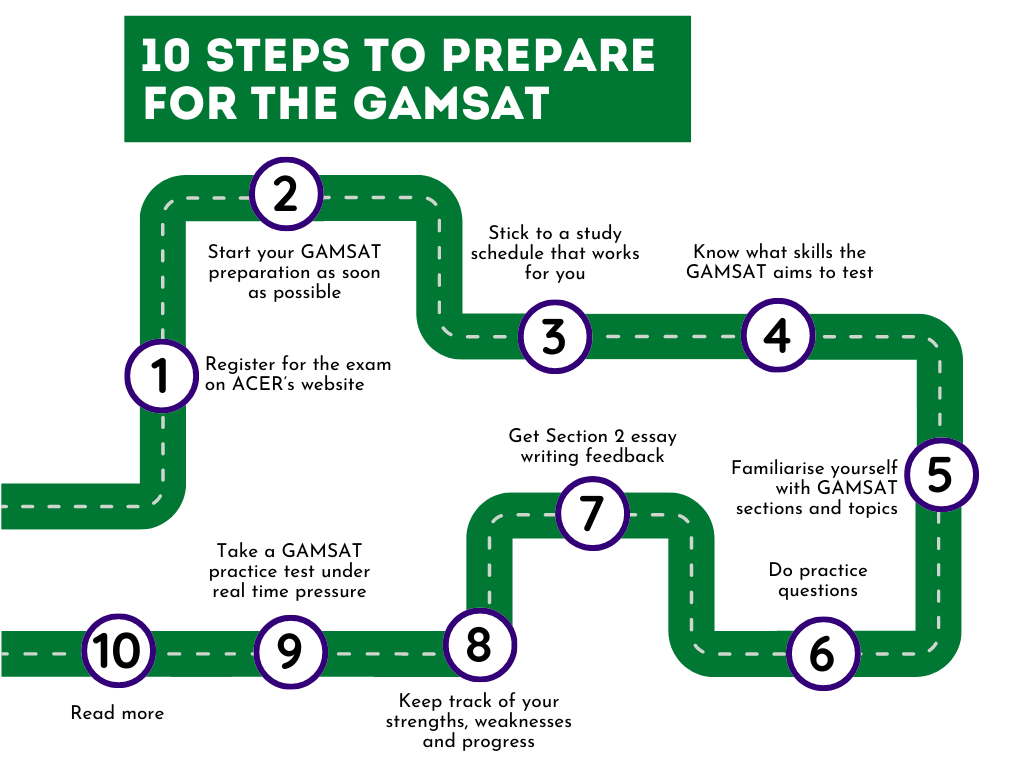
Visit ACER’s website to register for the GAMSAT ® exam in 2026. Below you will find more details about 2026 GAMSAT ® exam dates. Late registrations are allowed but will incur an extra fee, so make sure to register as soon as possible!
| March GAMSAT ® exam | September GAMSAT ® exam | |
|---|---|---|
| Test Date |
Written Communication:
28 February – 1 March 2026 Humanities and Biological Sciences: 20–22 March 2026 |
Written Communication:
22–23 August 2026 Humanities and Biological Sciences: 11–13 September 2026 |
| Registration Opens | November 2025 | May 2026 |
| Registration Closes |
Monday 26 January 2026
9pm AEDT 10am GMT |
Tuesday 30 June 2026
10pm AEST 1pm BST |
| Late Registration Closure |
Thursday 5 February 2026
9pm AEDT 10am GMT |
Monday 13 July 2026
10pm AEST 1pm BST |
| Refund/Deferral Request Closure |
Thursday 5 February 2026
9pm AEDT 10am GMT |
Monday 13 July 2026
10pm AEST 1pm BST |
| Cost | AUD$568 | AUD$568 |
| Late Fee | AUD$114 | AUD$114 |
| Results Available | Late May 2026 | Mid November 2026 |
GAMSAT ® Results are generally released about 2 months after sitting the exam - Around late May for the March sitting and mid-November for the September Sitting.
To learn more about how GAMSAT Results are calculated and see a list of past release dates visit our guide: Understanding your GAMSAT ® Results.
To learn more about sitting the GAMSAT ® Exam in 2026, visit our guide to everything you need to know for the GAMSAT ® 2026.
It’s a common question: when should I start preparing for the GAMSAT ® ? There’s no one correct answer, because it depends on many factors, such as whether you are familiar with physics, chemistry, and biology assumed knowledge or if you are doing GAMSAT ® preparation from a non-science background. Some students find the humanities sections easier while others find Reasoning in Biological and Physical Sciences Section easier. You can learn more about this in the section below.
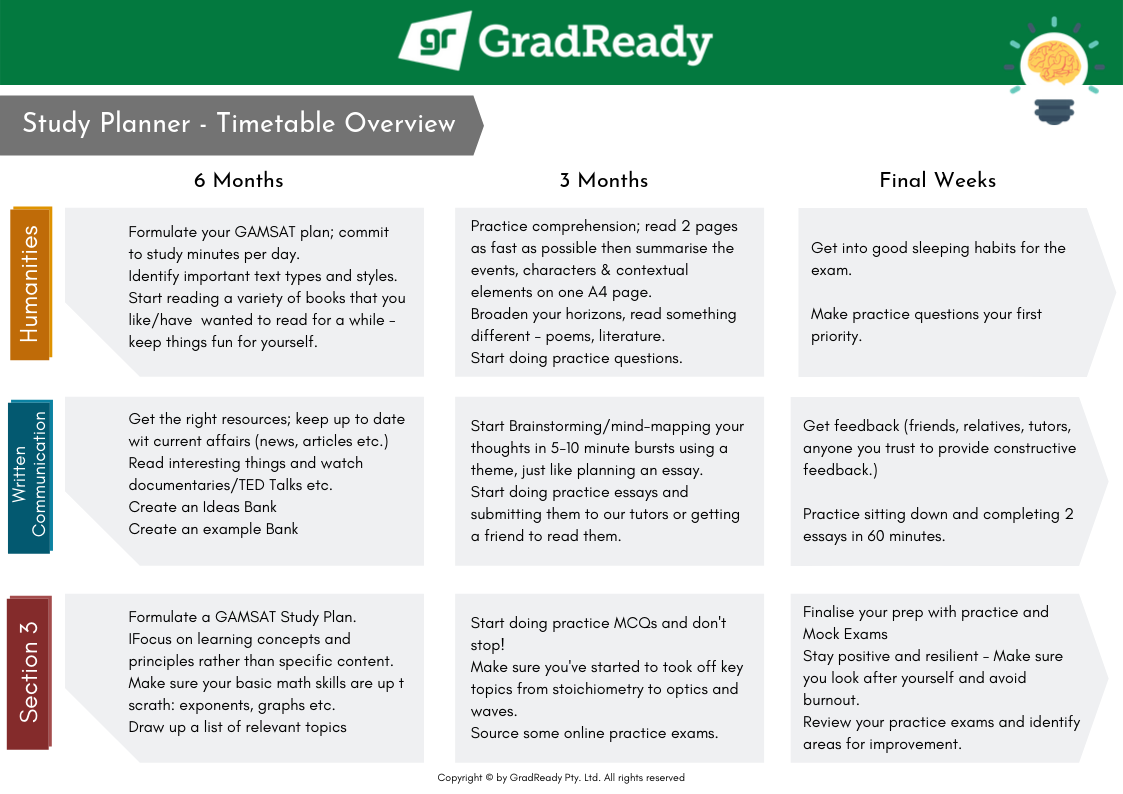
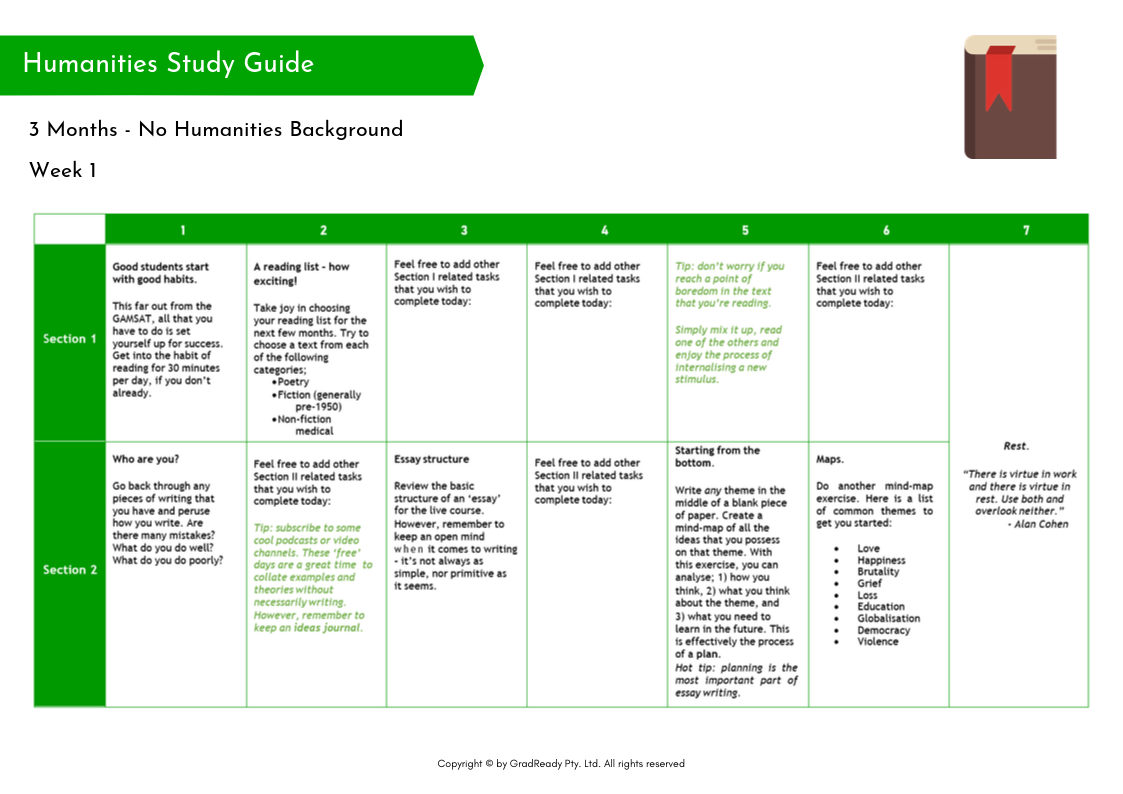
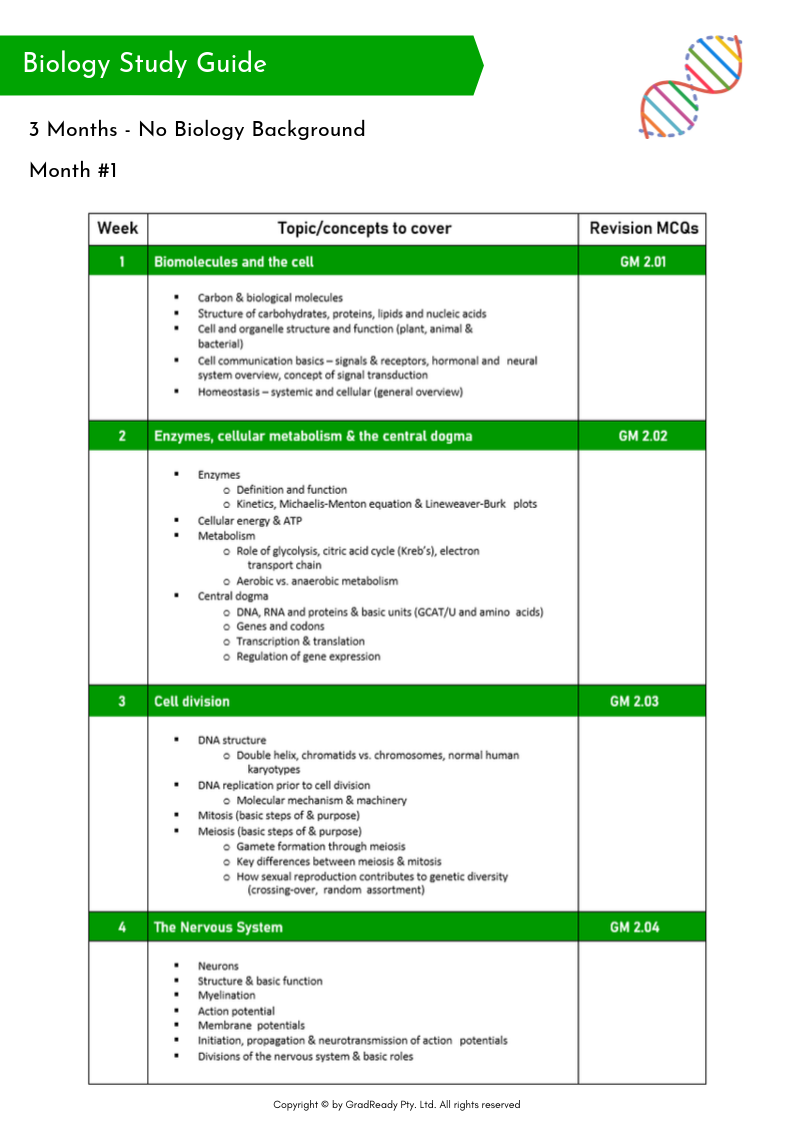
Students who lead busy lives tend to study for the GAMSAT ® whenever they can instead of following a specific study schedule. While it can be hard to stick to a schedule, this is very important in order to keep your GAMSAT ® preparation structured, effective, and efficient. We’ve done the legwork for you and prepared a GAMSAT ® study schedule that you can use as a starting point and adjust as required.
The Reasoning in Humanities and Social Sciences Section consists of humanities multiple choice questions. Written Communication Section is an essay-writing section. The Reasoning in Biological and Physical Sciences Section contains science multiple choice questions - 40% Biology, 40% Chemistry, and 20% Physics. Practice questions are the key to any GAMSAT ® preparation because there’s only so much you can learn from reading textbooks.
Sign up for our GAMSAT ® Free Trial to get access to 40 free MCQs as well as a wealth of other preparation materials to help you kickstart your preparation!
It’s good to practice writing essays for Written Communication Section, but if you don’t get feedback for your essays, it will be hard to figure out how well you did and how you can improve. At GradReady, we provide GAMSAT ® essay marking services where our tutors will provide expert feedback to help you improve.
The GAMSAT ® is unlike any other exam you’ve taken before in that it covers such a wide range of topics. Naturally, you will be strong in some topics and weak in others. At GradReady, we’ve designed our MCQ system to automatically track your performance across the 4 subject areas and 26 subtopics. Use this information not only to guide the focus of your studies but also to compare your performance with other GradReady students.
Sign up for our GAMSAT ® Free Trial to get access to 40 free MCQs and test our advanced online learning system for yourself!
Once you feel like you’ve sufficiently prepared, it’s time to take a GAMSAT ® practice test.
Our free GAMSAT ® Practice Test gives you access to Reasoning in Humanities and Social Sciences and Reasoning in Biological and Physical Sciences MCQs of varying topics and difficulty levels, similar to the actual GAMSAT ® exam. You will complete the practice test on our online exam platform which is designed to closely mimic the official ACER GAMSAT ® exam, giving you the option to put yourself under realistic time pressure and helping you to familiarise yourself with the online delivery of the exam before test date.
Sign up for our Free Trial to get access to our GAMSAT ® Practice Test as well as heaps of other free resources!
Try to read more in your spare time. Reading widely will help improve you Reasoning in Humanities and Social Sciences Section and Written Communication Section score. Check out our blog article on What to Read for the Humanities Section of the GAMSAT ® Exam for some tips and recommendations.
Overall, the GAMSAT ® exam can be incredibly overwhelming and it can often feel like a challenge in and of itself to just start your GAMSAT ® prep. There’s also the question of how long it takes to study for the GAMSAT ® , which we’ve addressed separately below: How long do I need to study for the GAMSAT ® ?
The confusion exists primarily because there are a wide range of diverse and often conflicting opinions as to how to best prepare for the GAMSAT ® exam. Here at GradReady, we’ve tried to filter out all the noise, simplify the process and break it down into the following no-nonsense approach to help you start your GAMSAT ® preparation. The best thing about this approach is that it can be adapted as a general set of principles to how you, as an individual, study best, and provides you with a framework to best prepare for the GAMSAT ® exam.
Treat GAMSAT ® exam preparation as four phases rather than one long content slog. The calendar length changes with your background; the sequence should not.
Please move to desktop to view the entire table without additional taps.
| Phase Phase |
Focus Focus |
Typical timing Typical timing |
|---|---|---|
| 1. Diagnose 1. Diagnose |
Short mixed practice, identify weak sections, and map assumed-knowledge gaps. Short mixed practice, identify weak sections, and map assumed-knowledge gaps. |
Week 1 Week 1 |
| 2. Build foundations 2. Build foundations |
Cover first-year biology and chemistry and Year 12 physics where needed; read widely; start an essay idea bank. Cover first-year biology and chemistry and Year 12 physics where needed; read widely; start an essay idea bank. |
Early months Early months |
| 3. Practise with strategy 3. Practise with strategy |
Topic MCQs, timed essays with feedback, and an error log so review stays diagnostic. Topic MCQs, timed essays with feedback, and an error log so review stays diagnostic. |
Mid preparation Mid preparation |
| 4. Simulate the exam 4. Simulate the exam |
Timed section blocks, full practice tests, official ACER materials, and the Online Platform Demo. Timed section blocks, full practice tests, official ACER materials, and the Online Platform Demo. |
Final 4–6 weeks Final 4–6 weeks |
Use the GAMSAT ® study schedule to turn these phases into weekly hours. Keep this page for the method: what to practise, how to review, and how to keep all three sections in play.
Before you lock a 3-month or 6-month plan, studying for the GAMSAT ® should start with a short mixed diagnostic — not a full official paper on day one. The diagnostic answers three questions:
Use free GAMSAT ® practice questions for that first pass. Save official ACER Practice Test A and B, and the online interactive tests, for later timed simulation. Confirm current section timing and assumed knowledge in the ACER GAMSAT ® Information Booklet, then put the diagnostic result into your weekly timetable and the GAMSAT ® topic checklist.
The GAMSAT ® Exam is broken down into three major sections and we have three separate guides that provide specific tips on preparing for each section:
62 MCQs, 100 Mins
This section is designed to assess reading comprehension and the ability to apply this comprehension and understanding of the humanities in an MCQ environment. Questions contained within the Reasoning in Humanities and Social Sciences section are variable in their content, length, and difficulty. There may be interpretation of cartoons, analysis of poetry, comprehension of extended passages from famous works of literature, and questions relating to political understanding. Choosing the 'best' answer among options is an important skill to acquire.
Visit our: How to Study for Reasoning in Humanities and Social Sciences Section
2 Essays, 65 Mins
For this section, you are provided with two writing tasks. ACER currently presents each task as four statements on a common theme; you write one response per task (about 30 minutes each, 65 minutes in total). The first task deals with socio-cultural issues and the second with more personal and social issues. Many different styles of writing can be used. Some students like to use an argumentative essay for the socio-cultural task, and a reflective or creative essay for the personal/social task; however, many students write successfully using the same style for both. ACER assesses the quality of thinking about the topic and the control of language as it contributes to overall effectiveness — not the ‘correctness’ of your opinions. The 2026 Information Booklet also states that spelling and punctuation errors will not impact Written Communication scores. It's important to note that in the past few years we have noticed a shift towards ACER marking creative/reflective responses more harshly, and favouring argumentative responses.
Visit our Guide: How to Study for Written Communication Section
75 MCQs, 150 Mins
The GAMSAT ® ACER website advises that first-year tertiary levels of biology and chemistry are assumed knowledge, along with year 12 level physics. The Reasoning in Biological and Physical Sciences Section is built upon long, complex passages in which you must work to unpack the relevant information and solve the presented problem. It is also double-weighted (exceptions apply – visit our Guide to GAMSAT ® Results to learn more), making it the most important section in the GAMSAT ® Exam. In addition, the majority of universities across Australia require a score of 50 in all three sections to be eligible for selection, so practicing and perfecting strategies for Reasoning in Biological and Physical Sciences Section is imperative. It is important to note that although any direct recall-type knowledge of the sciences is not required, a working ability with the sciences at the required level is essential in understanding the questions.
Visit our Guide: How to Study for Reasoning in Biological and Physical Sciences Section
For more information about the GAMSAT ® Exam itself, visit our guide: What is the GAMSAT ® ?
Here at GradReady, we strive to provide the Gold Standard in GAMSAT preparation. We do this by organising our GAMSAT ® Preparation Strategy under three key stages:
Please move to desktop to view the entire table without additional taps.
| Step Step |
Description Description |
|---|---|
| Build the foundational content and knowledge Build the foundational content and knowledge |
Textbook, videos, and tutor help Our
GradReady Students
have access to our 1200+ page GAMSAT ®
Textbook as well as over 22 hours of videos to provide them with all the tools they need to establish this essential foundation. In addition, as a GradReady student, if you ever need any further help with a particular concept or subject, our GetClarity system allows you to directly contact a GAMSAT ®
Tutor who specialises in your area of query anytime – it’s just like having a personal tutor at your fingertips.
|
| Apply knowledge and strategy Apply this knowledge and develop a GAMSAT ®
Exam and MCQ Strategy
| Live classes focus on reasoning We ask our students to prepare for our live classes by reviewing the content beforehand in order to allow our GAMSAT ® tutors to focus their time on teaching you to develop an exam strategy. As the GAMSAT ®
exam has shifted towards challenging your reasoning skills in recent years, our courses have evolved accordingly to focus on developing your logical reasoning and giving you the skills to take MCQs apart.
|
| Practice under accurate conditions Practice with realistic questions under accurate conditions
| Exams, MCQs, and mock exam As a GradReady student you will have access to 15 Intelligent Online Exams, over 8000 MCQs, and the most realistic Mock Exam out there, featuring percentile reporting for your overall performance and a breakdown for each section that compares you to thousands of GradReady students, past and present.
|
To learn more about our GAMSAT ® Preparation courses and compare their different components, view an in depth comparison here: GradReady Course Comparison
If you want to try out our industry-leading learning technology and student LMS for yourself, sign up for our GAMSAT Free Trial today!
The most crucial aspect of studying effectively for the GAMSAT ® exam is planning – this is the key first step to help you start preparing for the GAMSAT ®. Planning study by month, by week, by day, and often by hour, is typically necessary to ensure that you’re well covered on all the sections of the GAMSAT ® exam, and allows you to achieve the necessary amount of question-based practice.
Setting goals using the SMART algorithm is an important aspect of the planning stage, and this acronym stands for the following (with GAMSAT ® -type example/questions to reflect upon):
S: Specific
Is the topic useful for the exam? E.g Is studying clinical pharmacology specific for the GAMSAT ®
?
M: Measurable
Where does this specific part of study end? Reading a certain number of pages, chapters, etc.? Or answering a certain number of questions?
A: Achievable
Is it realistic to achieve this? E.g Can you read every piece of English-translated classic literature prior to the exam?
R: Relevant
Are these readings/questions relevant to the GAMSAT? Are these questions, which require direct knowledge recall, relevant for study?
T: Time-sensitive
Are these goals defined by time? Complete by the hour/day/week?
SMART goals are a great tool to ensure that you remain focused on what matters in your preparation and that you make real, measurable progress.
When planning your study, a good approach is to set up a calendar or journal, and start at the very last date – usually when the next GAMSAT ® exam is, and work backwards.
For further tips on planning your time, check out the suggestions here: Balancing GAMSAT ® and Work
For a better idea of how much time you should aim to spend on your preparation, check out the section below: How much should I study for the GAMSAT ® ?
Our Free Trial includes a GAMSAT ® Study Guide with a week-by-week study schedule for each section to help you plan out your preparation, as well as key excerpts from our 1200+ page Textbook.
Sign up to access the study schedule as well as a wealth of other free GAMSAT ® resources:
Once you’ve set up a study schedule you can begin to plan the details of your study sessions – this will help you set goals for your study, and help you avoid getting bogged down trying to work out which things to prioritise.
The following points are key to follow:
A common erroneous belief is that the longer the time spent studying, the more you will cover. In fact, it is more likely that you will absorb information more effectively in the long-term if you take small breaks every 45 minutes. Break up your study and restore your mental energy. A useful time management technique is Pomodoros - you can learn more on our blog here .
In addition, get into the habit of studying at the same times each day to establish a good routine. Routine is particularly important in times of high stress such as right before exams. If you have a routine that involves study, eating, and sleeping at the same time each day, it eliminates the stress that comes with uncertainty. It also trains your brain to concentrate better between these times. For example, if you are more of a morning person, get up at 7am and study until mid-afternoon. Alternatively, if you’re a late night studier, assign study time between 3 and 10pm, for example. Ideally, you don’t want to be studying any later than 10pm to allow you a proper night sleep – unless of course you only thrive on late-night study!
Goals help you stay focused and allow you to monitor your progress, as created through the SMART template above. At the beginning of each day, write a list of all the things you aim to complete in the day. As you sit down in each session (which, as above, should be ~45 mins), write down exactly what you want to achieve in that time (for example, “complete 30 Reasoning in Biological and Physical Sciences Section MCQs”). The key to making this skill a successful one is being realistic! Don’t try and be ambitious: if you have heaps to do, don’t rush it, just take a bit more time to do it.
You need to know what to actually study, and this can be the hardest part of studying for the GAMSAT ® exam. It’s important to make sure that you’re familiar with the content and structure of the exam. To learn more, you can read our introductory overview: What is the GAMSAT ® ?
Make sure that you’re familiar with each Section of the GAMSAT ® exam, and work out where your strengths and weaknesses lie. For more information you can refer to the specific guides for each individual section below, which contain section-specific tips as well as a breakdown of the content:
Download our GAMSAT ® Study Syllabus for a full list of Reasoning in Biological and Physical Sciences Section topics as well as tips and advice for Reasoning in Humanities and Social Sciences Section and the Written Communication Section:
Once you've worked out what, when, and how to study, it's time to practice. GAMSAT ®-style questions are a vital part of GAMSAT ® preparation after you understand what each section assesses. Start with free GAMSAT ® practice questions to learn the style, then use a topic MCQ bank (for example acids and bases after a chemistry chapter) to consolidate. Track wrong answers by theme so practice stays diagnostic rather than random grinding.
It’s important to remember that the GAMSAT ® is an exam that tests your reasoning and problem-solving skills rather than your recall of specific content. As such, it's pointless to try and study for the GAMSAT ® exam as if it were a knowledge-based exam (that is, by trying to memorise endless amounts of information to try and regurgitate in the test). In this respect, practice of GAMSAT ® - style questions can often be the most valuable use of your time – it allows you to develop problem-solving skills and familiarises you with the style of questions you’ll face on the day. If you get stuck with content with which you're unfamiliar, you can then go and supplement this by reading in the textbook or watching videos about it. To learn more, visit our introduction to the GAMSAT ® : What is the GAMSAT ® ?
Vitally, you should acquire as many practice resources as you can – MCQs and essay stimuli. Find tests online by googling the topic, or use the materials from GAMSAT ® preparation courses. It is also highly recommended that you save and use official ACER GAMSAT ® preparation materials as the final benchmark of your preparation. ACER produces the only official materials — currently e-booklets and online interactive practice tests — and Practice Test A is included with GAMSAT ® registration.
The GAMSAT ® exam requires a lot of mental stamina, and it is recommended that you eventually work up to practising under exam conditions.
ACER’s test-taking strategies should shape later timed practice:
How to practise for the GAMSAT ® works best as a ladder. Do not jump straight to a full official paper, and do not stay untimed until the week of the exam.
Please move to desktop to view the entire table without additional taps.
| Stage Stage |
What to use What to use |
Goal Goal |
|---|---|---|
| 1. Untimed style 1. Untimed style |
Free questions and topic MCQs
Free GAMSAT ® practice questions,
topic MCQs, and untimed essays
| Learn question types and review every miss. Learn question types and review every miss. |
| 2. Timed blocks 2. Timed blocks |
30-minute Task A/B essays; 20–30 MCQ sets. 30-minute Task A/B essays; 20–30 MCQ sets. |
Build pacing without full-exam fatigue. Build pacing without full-exam fatigue. |
| 3. Section simulations 3. Section simulations |
100-minute Section 1; 65-minute Section 2; 150-minute Section 3. 100-minute Section 1; 65-minute Section 2; 150-minute Section 3. |
Train stamina for each paper. Train stamina for each paper. |
| 4. Official benchmark 4. Official benchmark |
ACER official materials ACER e-booklets, online interactive tests, and the
Online Platform Demo
| Match official item style and the test application. Match official item style and the test application. |
After every set, keep a simple error log: question theme, error type (knowledge, stem-reading, timing, or careless), and the next drill. That log is what turns GAMSAT ® self-study into targeted revision instead of random grinding.
As part of our GradReady GAMSAT ® Preparation Courses, we focus on this first step of developing MCQ and exam strategies, then building stamina through the Online Intelligent MCQ Bank and practice exams.
Reflect after every set. Get a second reader to mark essays, and read your own essay aloud to check structure. For MCQs, classify each miss — simple error or a topic to revise — and keep a list of weak themes.
Our Online Intelligent MCQ Bank tracks performance across 43 subcategories and links you to the matching textbook chapters and videos. Try it with 40 free MCQs in the GAMSAT ® free trial.
Got half an hour to spare on the train? Reading is one of the easiest ways to maximise your spare time and study for the GAMSAT ® exam as you can do it anywhere, anytime.
Many students who are from a science-based background may find the humanities sections particularly difficult, as they focus upon a very broad and thorough grounding in the humanities. Reading poetry, opinion pieces, scientific journals, political analysis, or novels is all extremely helpful. Reading improves vocabulary, increases awareness of socio-economic and political issues, and fosters creativity for essay-based writing. Some good sources for increasing your political awareness and accessing news are listed below. It’s important to be up-to-date in current affairs for the humanities sections in the GAMSAT ® , and not to mention the medical interviews.
In essence, anything that will broaden your knowledge base can be useful. However, make sure you’re not just skimming over things. Analyse what the author is saying and form opinions on the content. To get more tips on preparing for the humanities sections of the GAMSAT ® exam, visit the below guides:
The overall point is to find ways to incorporate study into your daily routine – read the paper with breakfast or read blogs at lunch instead of scrolling through social media. There are a number of apps that can help with your reading, including ones that send you a poem per day to read. Another tip is to follow newspapers, websites and other sources of information on social media. Their posts will pop up in your newsfeed, prompting you to read, even while procrastinating.
To help you learn on the go, our newly updated GradReady Online Learning Management System now features a mobile-friendly experience. Because our system is proprietary, we are able to constantly make updates in line with student feedback to ensure that students are getting the best learning experience possible. With our new update, you can now utilise our Intelligent MCQ Bank whenever and wherever your phone goes. You can read our textbook or view our course videos on the go and maximise your spare time.
To test out our new online learning system, sign up for our free trial today.
The best way to prepare for the GAMSAT ® is not a secret resource list. It is a repeatable GAMSAT ® study strategy: diagnose, cover assumed knowledge, practise GAMSAT ®-style questions, review every miss, get Written Communication feedback, then add time pressure on a computer.
ACER does not publish a topic-by-topic curriculum, which is why GAMSAT ® exam preparation feels unstructured at first. Use the GAMSAT ® study syllabus as a checklist, not as a textbook to memorise. Then keep all three sections in weekly rotation so humanities, writing, and science reasoning improve together.
If you only do one thing after reading this guide, sit a short diagnostic this week and book the next timed essay. Familiarity with question style and timing is what makes studying for the GAMSAT ® transfer to test day. For a section-by-section skill map, see GAMSAT ® sections: a breakdown.
Time pressure is the difficulty most candidates report. ACER’s current format is two sittings with a total test time of 5.25 hours: 65 minutes for two Written Communication tasks, 100 minutes for 62 Humanities MCQs, and 150 minutes for 75 Biological and Physical Sciences MCQs. In every section, many candidates struggle to finish. Passages are long, graphs and tables are dense, and you cannot bring a calculator.
The GAMSAT ® is hard because it is not a memorisation exam. It asks you to apply ideas from more than one discipline, make plausible inferences, and write a controlled argument in 30 minutes. That combination of reasoning, written communication, and scientific problem-solving — under a computer-based time limit — is what separates it from typical university assessments.
The practical implication for GAMSAT ® preparation is that difficulty is trainable: pacing, stem-reading, and stamina improve with timed practice. For tutor commentary, see how hard is the GAMSAT ®.
According to a review of 50 scientific studies with more than 130,000 participants, the answer is a resounding yes. In fact, preparation for any sort of test works and GAMSAT ® preparation courses are especially helpful – there is no reason to believe that the GAMSAT ® exam would be any exception.
Here's an excerpt from an August 2015 Harvard Business Review Article explaining why test preparation works:
A review of 50 scientific studies with more than 130,000 participants shows that practice boosts performance on pretty much any kind of test, for three reasons. First, it decreases anxiety. As you’d imagine, the more trial runs you’ve had, the more confident and calm you’ll be when taking a high-stakes test, because the various formats and questions, as well as the entire experience, will seem more familiar. You’ll also discover what you don’t know, so you can brush up and feel more prepared. Second, practice makes proven test-taking strategies, such as skipping and revisiting difficult questions, come more naturally when the pressure is on. You’ll learn to ignore irrelevant information and make fewer errors in interpretation. And third, repeated test taking can help you develop the very qualities that employers measure. Harvard Business Review (Ace the Assessment)
Applying the above concepts to the GAMSAT ® exam, here's why GradReady GAMSAT ® Preparation Courses work:
Let's look at this another way: imagine that you are driving to your lodge in a small town during a trip in a new country. Maybe you think that your brain and a map are all you’d need, and that you’d make it to your destination easily. But that's only in theory. In reality, you probably stopped to ask for directions, you were probably confused and distracted by the various foreign road signs and driving norms, and you probably had to turn back a few times due to mistakes. In reality, the drive was a lot more difficult than you thought, and a local person, who is more familiar with the roads will always get to the destination faster and make less wrong turns than you would – even if you’re a renowned rally driver. But it's okay, you weren't in a race; you weren't competing against the local person.
Now look at the GAMSAT ® exam. The GAMSAT ® exam is the drive. Some people say that all you need are the general skills that you’ve picked up throughout your life – that is your brain and map in our previous scenario. But that's only in theory. In reality, you need guidance, you would benefit from being taught to recognise the various conventions and question types in the GAMSAT ® exam, and you do not have the time to constantly go back to correct your mistakes. In reality, if you are familiar with both the core concepts and how to approach questions based on those concepts, you will always do better than someone who is not.
Our GradReady GAMSAT ® Preparation Courses show you what it means to be truly familiar with the GAMSAT ® exam, and that's why our students do so well. Check out our statistically significant student results over the last 12+ years to learn more: GradReady student results.
The GAMSAT ® exam is a difficult exam with many different aspects to it. Of course you can sit the exam without studying, and some people may find it easier than others, but broadly speaking, most people will need anywhere from 3 to 6 months to fully prepare for the GAMSAT ®.
Many people like to have a ‘trial runthrough’ of the exam, just to see what to expect. However, even if you want to have a ‘test run’, you will get more out of the experience if you have done some study beforehand.
Even if you do have a background that helps you with some areas of the exam, it’s important to recognise that the GAMSAT ® is different to school or university assessments. It’s not something where knowledge per se is the key - it’s your ability to understand and reason with the information given to you.
This is a really big question. The GAMSAT ® exam exceeds 5 hours of testing time and draws on more content than you have likely ever been tested on in a single occasion before. This is coupled with the fact that the GAMSAT ® exam is primarily designed to test your reasoning skills and is therefore unlike any of the knowledge recall exams you would have done throughout your tertiary studies. The first thing to do when studying for the GAMSAT ® is to make sure you have an understanding of each section so that you can begin to understand what each section is designed to test you on. This can be found in our comprehensive guides for each section:
Now that you know what each of the sections entail, it is essential to have a compact and concise study syllabus that reminds you of all the areas you need to prepare for and allows you to organise your study in an efficient way. At GradReady, we have tried to do this for you in the best way we know how - by creating our own GAMSAT ® study syllabus. Our syllabus is a brief overview of the exam and how to best approach it by summarising the recommended content for each section and providing expert study tips along the way. You can choose to use it to kickstart your study, or as a way to check off topics as you go. You can access it for free here.
As with any exam, what you need to focus your study on will depend upon your strengths and weaknesses, and your own background. If you have a background in chemistry, for example, you may not need to focus on chemistry questions as much.
A good way to assess what you need to study is to give some questions a go. GradReady has a GAMSAT ® practice test for students to sit, which is a good place to start. If you then identify a topic with which you’re particularly uncomfortable, this can be a good place to start your study.
If you’re still not sure how to break down your study, however, using a structured approach like the GradReady textbook and MCQ bank is helpful. Our MCQs are split into different topics, e.g ‘electrochemistry’, or ‘acids and bases’, depending on what the main focus of the question is. You can try splitting your remaining time before the exam into chunks according to each section. For example, you may like to try spending two days on acids and bases, with the first day dedicated to understanding content (watching tutorial videos, reading the textbook, etc), and the second day dedicated to practising MCQs from this topic to consolidate your learning.
The short answer is yes. However, the long answer is much more complex. Having a background in the sciences will undoubtedly be useful for Reasoning in Biological and Physical Sciences Section of the GAMSAT ® exam - however it should be stressed that you do not need to have done an undergraduate degree in the sciences to do well in this Section. As mentioned previously, the GAMSAT ® exam is not designed to test your ability to recall pieces of information; rather all the information needed to answer the question is provided to you. It is up to you to use an appropriate set of skills which are deemed conducive to pursuing a degree in the medical field. In many ways, this has levelled the field for students with non-science backgrounds. In addition, it's worth noting that most medical schools have removed prerequisites for graduate-entry medicine: all sorts of undergraduate degrees and backgrounds are welcome with the goal of creating a more diverse medical workforce.
That being said, a familiarity with basic science fundamentals and an understanding of the scientific method will help you engage with the content and ideas presented to you in the Reasoning in Biological and Physical Sciences Section, it will also help you make reasonable scientific judgements. This is akin to solving a puzzle with some pieces already put together for you and an idea of the final image, rather than starting a puzzle from scratch with no idea what the image will be.
For students from pure science backgrounds, while it is true that you may already have a firm grasp of the basic fundamentals needed for the Reasoning in Biological and Physical Sciences Section, this is no guarantee you will do well. In many ways, your scientific knowledge is double-edged: While it may give you a tremendous grasp of the scientific content presented to you, this knowledge can simultaneously hinder your ability to assess the questions and exam in an unbiased fashion. There will be an tendency or instinct to answer every question in a manner similar to your approach in previous science exams and a self-expectation that this will be your “bread and butter” section. You will find however that while the questions may seem familiar at face value, you will be forced to use the information provided to you.
Overall, the message for students is to treat Reasoning in Biological and Physical Sciences Section of the GAMSAT ® exam as its own separate entity. Do not be disheartened if you have not done much science nor be too dismissive if you have done lots of science, it is essential that students become familiar with the style and approaches required for this section.
The GAMSAT ® is an extremely daunting, challenging, and unfortunately necessary part of graduate-entry medicine. It’s an exam that students will typically sit more than once. Therefore, how can you go about ensuring that you can improve between sittings?
It is common knowledge that there are some standards of assumed background knowledge for Reasoning in Biological and Physical Sciences Section of the GAMSAT ® exam. ACER advises that the level of knowledge required for this section corresponds to the first year tertiary levels of biology and chemistry , along with a year 12 level of physics - a list of topics with assumed knowledge can be found in our free GAMSAT ® study syllabus or on our Reasoning in Biological and Physical Sciences Section page. Whilst the GAMSAT ® exam has definitely moved away from direct rote learning of the sciences and towards problem-solving, it is important to understand that a baseline comprehension of the sciences is necessary to give yourself the chance to break down and interpret the questions quickly.
When it comes to sections 1 and 2, many students believe that there are no expectations of background or prerequisite knowledge. Whilst this is technically true, both of these sections require a significant appreciation of global and social issues if students wish to excel in them. More specifically, the Reasoning in Humanities and Social Sciences Section requires the understanding of a range of text types, including interpretation of cartoons, analysis of poetry, comprehension of extended passages from famous works of literature, and questions relating to political understanding. Students should become familiar with all of the above text types and more, and might find it useful to begin reading up on important social science issues through newspapers, phone apps or social media. When it comes to the Written Communication Section , students will again be tested on social and cultural issues, but this time through the medium of personal writing. Again, students must be very well-read and well-informed on global issues, and must have an evolved and captivating writing style. ACER specifically states that responses that have been pre-prepared and do not relate to the provided themes will not score well. This only highlights the importance of having a broad range of knowledge on socio-cultural issues so that you are able to adapt and think on the spot to develop an engaging and thought-provoking piece of writing.
As previously explained, in recent years the GAMSAT ® exam has moved away from testing direct science recall and towards general skills in problem solving, logical reasoning and critical thinking. Whilst the multiple choice style of questioning remains the same, the questions themselves have transformed to include long passages, graphical and tabulated displays of information, and mathematical relationships.
For the Reasoning in Humanities and Social Sciences Section , students are expected to unpack and interpret socio-cultural and interpersonal concepts through a range of text types and stimuli. Here’s an excerpt from the ACER GAMSAT ® information booklet 2026 describing the main types of questions found in Reasoning in Humanities and Social Sciences Section:
Questions in the Reasoning in Humanities and Social Sciences section demand varying degrees of complex verbal processing and conceptual thinking, logical and plausible reasoning, and objective and subjective thinking.ACER GAMSAT ® Information Booklet
- Questions that emphasise understanding involve the recognition of explicit and implicit meanings through close reading of words and phrases and global interpretations of text.
- Questions that emphasise plausible reasoning involve interrelating, elaborating and extending concepts and ideas, and drawing conclusions.
- Questions that emphasise critical thinking require candidates to make discriminations and judgments in the realm of plausible reasoning.
For the Written Communication Section , there is not as much emphasis on problem solving per se, but assessment of the standard of writing is made based on the student’s quality of argument and thought as well as their control of language to articulate their ideas and opinions.
The Reasoning in Biological and Physical Sciences Section is typically the most challenging component of the exam in regards to problem-solving. Students must have well-developed skills in data interpretation, logical reasoning and critical analysis. For example, students may receive a passage of information about an unknown scientific domain that is accompanied by a graph or table. Questions for this unit may then revolve around interpreting the data within the graph or table, discovering relationships between text and data, extrapolating or interpolating evidence, formulating hypotheses and deducing consequences. Students will not be expected to have any pre-existing knowledge of the science that underpins the unit, rather they should be able to work with the information on the page to deduce the answer. These skills can predominantly be expanded on with repeated long-term practice of multiple choice questions, giving students the chance to also see patterns and strategies emerge.
Another common error students make is to only focus on 1 or 2 sections and hope that this will outweigh any deficits in the other section(s). It is highly recommended that you dedicate time to work on all sections of the GAMSAT ® exam, not just one or two sections. While the overall GAMSAT ® score is calculated with Reasoning in Biological and Physical Sciences Section doubly weighted , some universities use an average GAMSAT ® score in which each section is weighted equally (placing an importance on all sections), and the University of Sydney ranks students by each section separately. Therefore, to maximise your chances of success, you should work on every section of the exam which would give you both a strong average score and overall score.
Furthermore, many universities require a score of 50 in each section as a minimum to even be eligible for interview selection. You would not want to place yourself in a situation where you do amazingly well in 2 sections only to score under 50 in one section, rendering you ineligible. As you’re unable to mix and match scores across different sittings, your high performance in the other sections would be invalidated.
There are nuances to each section and it is remarkably important that you have a good grasp of what each section will look like and what is expected of you. A good example of this is the Written Communication Section - many students expect that just because they were good essay writers in high school, it means that they will ace the Written Communication Section with no trouble, and so do not take the time to learn about the nuances of the section such as what common themes include, testing different essay styles, or how long to spend on each essay so you don't run out of time. Another example is not being well-read on a range of global and social topics, or not staying up to date with current affairs. If you think about it, the GAMSAT ® exam tries to draw out a whole range of skills and traits that we aim to cultivate in future doctors, and being well-rounded and well-informed is invariably important.
Students who already possess the assumed knowledge specified by ACER (first year tertiary levels of biology and chemistry, along with year 12 level of physics) will usually need around three months or less to prepare for the GAMSAT ® . Students that come from a non-science background will usually need around six months in total to prepare. More advanced students can complete their preparations in one to two months. The amount of time students dedicate to GAMSAT ® study everyday is usually around 3 to 6 hours.
Various candidate-specific factors obviously influence the amount of revision that is required to firstly understand the basic concepts in the GAMSAT® exam. However, in a practical sense, in trying to determine how much time you need to prepare for the GAMSAT ® exam, it is much more important that you study up to a point where you are able to answer GAMSAT ® - style questions quickly and accurately. This means you should aim to do a few practice tests (at least). It’s recommended that you start your GAMSAT ® prep early in order to give you time to identify your weaknesses. This subsequently means that you’ll have a considerable amount of time to improve them, which is important especially if you are a cautious candidate or a candidate from a non-science background. To learn more on preparing for the GAMSAT ® exam with a non-science background, visit our guide here: GAMSAT ® Exam Preparation for Non-Science Backgrounds
Nevertheless, the GAMSAT ® exam is a diverse test, and even biomedical undergraduate and science undergraduate students should start studying early, as even they may require tutelage and direction in certain areas – especially the humanities, which is a general weak point for students with such a background.
Remember: even starting with one or two hours a week early on can make a huge difference to your preparation later down the line as the exam draws nearer.
Overall, we recommend that you start six months prior to sitting the GAMSAT ® exam, i.e in September if you are sitting the March GAMSAT ® exam. The reason is that you don’t know what you'll need to work on until you seriously start to plan your preparation for the GAMSAT ® exam. Six months should be enough time for you to work on your weaknesses without suffering from preparation fatigue. Remember: even starting with one or two hours a week early on can make a huge difference to your preparation later down the line as the exam draws nearer.
For tips on how you can start studying for the GAMSAT ® exam, read the section above: How to Study for the GAMSAT ®
It depends. The GAMSAT ® exam is a very challenging exam that assesses problem solving in very broad contexts. Therefore, GAMSAT ® preparation time should take this into account. For some, two months of dedicated GAMSAT ® study may be sufficient if study is the sole focus. However, most people have other commitments such as work, university, family, friends, etc. Therefore, two months will likely not be enough when accounting for these other responsibilities.
The duration of GAMSAT ® study needs to achieve two tasks - learning core concepts and practice problem solving. Given the scope of the GAMSAT ® exam, we recommend erring on the side of caution that two months may not be enough for most people to perform well in the GAMSAT ® exam. For such a high stakes exam, it's always beneficial to be a little bit too prepared than not prepared enough.
A rough estimate is that people usually need 3-6 months to prepare for the GAMSAT ® exam. Those who have sat the exam previously and are more familiar with its structure and GAMSAT ® questions may choose to spend less time, whereas others who are less familiar with the questions or don't have a strong science background may need more.
Study for the GAMSAT ® is an individual endeavour that should take into account one's financial resources, background knowledge, problem-solving skills, etc. Some people may not be able to take time off work, and therefore may only have less time to study. Others may have a really strong science background and need less time for GAMSAT ® Section 3 preparation.
Yes, GAMSAT ® preparation can occur while working full time. With a good and specific GAMSAT ® study schedule, GAMSAT ® prep is achievable even with a full-time workload (e.g paid employment, university studies, etc.).
However, keep in mind that GAMSAT ® study is challenging. If you have a full workload, GAMSAT ® prep will require discipline, and occasionally studying when one doesn't want to. Therefore, for individuals in this scenario, it may be beneficial to begin preparation several months in advance.
Again, it depends. The answer should be based on how much time you have available in a day and how early you start studying for the next sitting. Those with more time until the exam may do less hours per day, versus those with less time until the exam who will have to do more hours per day. It all depends on your starting point, both with time, and with familiarity with the assessable components in the GAMSAT ® exam.
A rule of thumb to get you started is to try and commit at least an hour, maybe two of good quality, targeted and distraction-free GAMSAT ® study per day. Additionally, weekends or days off may be a good opportunity to practice a bit more, whether it's practice papers or writing GAMSAT ® essays. If you feel you're progressing well, this might be a good fit, and if you aren't, you may need to allocate an extra hour per day. Remember, GOOD QUALITY study is far better than many hours of poor quality study.
Consider when you want to sit the GAMSAT ® exam and start GAMSAT ® preparation 3–6 months prior to the test date if you can — closer to 3 months if you already have the assumed science knowledge, closer to 6 months from a non-science background or with limited weekly hours. Also consider if you would benefit from additional learning resources such as free GAMSAT ® preparation materials and paid courses.
'The best time to start was yesterday, the next best time is now' is a truism that is often applicable. It's easy to read many different resources on the optimal way to study for the GAMSAT ® or how to structure the preparation. Just remember, you'll need to start at some point, and it's easiest to start with small, manageable steps.
So you’ve made more of a last minute decision to sit the GAMSAT ® exam or you didn’t realise how much preparation was necessary? That’s ok, not everyone has the luxury of months to prepare. If you find yourself with only a couple of weeks to prepare, there are some strategies and techniques to streamline your preparation and make sure you’re only studying the most high-yield content.
Firstly, let’s reinforce the idea that the GAMSAT ® exam is moving away from memorising specific scientific content and towards logical reasoning and scientific interpretation skills. This means that spending your limited time in the textbooks will not prove to be very helpful at all. Instead, it is most important to complete practice MCQs to pick up on patterns and general problem solving skills. If you get really stuck with a topic, you can then look it up. Completing MCQs can therefore give you a more targeted approach to learning content. Work on your MCQ strategy, and as a bonus, learn the science along the way with each answer. Try our industry-leading online LMS for yourself and access 40 Free MCQs with our GAMSAT ® free trial.
Once you’ve done a couple of papers, try to pick up on your areas of weakness - whether this be a particular branch of science, or maybe even components of reasoning in humanities and social sciences section and 2. Once you’ve found your weakness, focus a big chunk of the remainder of your time on working on this. While it may feel like the less daunting avenue, there’s not a huge amount of usefulness in continuously repeating and relearning topics that you are already familiar and comfortable with. You may find that you may need to quickly step into the textbooks and learn a bit of theory before jumping back into the practice questions of your weak area. Alternatively, you may find that you need to seek out more exemplar essays before focusing on writing essays and getting your friends and family to read and critique them. Maybe you thought that the reasoning in humanities and social sciences section was all about reading and comprehension, and have now realised that you want to read up and become better versed in different text styles. Whatever it is, you should now turn your focus here.
As mentioned above, students - particularly science students - often neglect sections 1 and 2 of the GAMSAT ® exam. Whilst there is some logic in this - the Reasoning in Biological and Physical Sciences Section is often double-weighted after all - many students find that not performing as well in sections 1 and 2 are what let their overall mark down. On top of this, most universities require you to score a minimum of 50 in each section, regardless of your overall score. Even if you have a limited time to study, make sure that you do not neglect any section. In a limited time frame, this may mean reading through exemplar essays , downloading newspaper apps on your phone to read in your spare time, or as always, completing practice MCQs for reasoning in humanities and social sciences section.
The GAMSAT ® is a computer-based exam. For current sittings, Written Communication is completed in an earlier remote-proctored window; Reasoning in Humanities and Social Sciences and Reasoning in Biological and Physical Sciences follow at a test centre about three weeks later. That split is a GAMSAT ® study constraint, not just a logistics detail: your Section 2 writing needs to be exam-ready before the first window, while Section 1 and Section 3 can keep building until the second sitting. Sitting dates and centre rules belong on the GAMSAT ® 2026 dates guide.
Please move to desktop to view the entire table without additional taps.
| Window Window |
What you sit What you sit |
Preparation implication Preparation implication |
|---|---|---|
| First sitting First sitting |
Written Communication (remote-proctored) Written Communication (remote-proctored) |
Peak typing, idea-bank use, and 30-minute Task A/B practice before this date. Peak typing, idea-bank use, and 30-minute Task A/B practice before this date. |
| Second sitting Second sitting |
Section 1 and Section 3 at a test centre, about three weeks later Section 1 and Section 3 at a test centre, about three weeks later |
Keep MCQ timing and screen-reading live. Do not stop Humanities or science practice after the essays. Keep MCQ timing and screen-reading live. Do not stop Humanities or science practice after the essays. |
Build these digital habits into how you study for the GAMSAT ®:
GradReady’s Intelligent GAMSAT ® MCQ Bank is built for this computer-based format: performance tracking across 43 subtopics, adjustable difficulty, and worked solutions. Because the system is proprietary, it can point you from a missed question to the matching textbook chapter, video, or tutor help.
Sign up for our GAMSAT ® Free Trial to test the online learning system for yourself.
The thought of having to work full-time while studying for the GAMSAT ® exam can be enough to deter the best of us making a start on our preparation. However, although you might not have as much time, if you’re organised and motivated, there’s nothing stopping you from excelling in the GAMSAT ® exam. The secret is in the planning: check out the section above on Planning out your GAMSAT ® Study.
Here are some extra tips for those of you currently in this situation:
One of the most important areas in preparing for the GAMSAT ® exam that students often forget is the art of looking after oneself. It can often feel overwhelming but it’s important that you practice self care: physically, emotionally, and mentally.
We can all lose our connections to the exterior world – we become insular, focused on the infinitesimally minute details. It’s important we don’t become so myopic that our vision for the future blurs; it’s important to maintain a view of the larger portrait before us.
How do you do it? Maintain your connections through text message and face-to-face contact with friends and family. Set aside the time to spend valuable and meaningful time with those people who form important support structures in your lives.
Moreover, part of effective study for GAMSAT ® exam is safeguarding against burnout and loss of interest. Ensure you’re well connected to those who are willing to support you through the emotionally distressing times and haul you out being stuck in a rut. If you find yourself caught in a dark place, secondary to GAMSAT ® exam study or a mixture of life’s throngs, empower yourself with the courage to seek help and speak with a guidance counsellor, your family doctor, or a trustworthy individual who can empathise with your situation and provide some way out.
At the end of the day, we’ve all got different priorities and commitments, so you need to figure out what works for you. But by planning ahead and being prepared for a hectic few months, you can at least tackle everything head on.
The competitive nature of the admissions process and the incredible cut-off scores seen for contemporary applications means that a re-sit and hopefully a corresponding score boost is often necessary to improve a student’s chances in the subsequent year. It is extremely difficult to rebound back into the GAMSAT again, as it is draining – especially as most people are taking holidays and relaxing over the holiday break! However, students should be comforted in the fact that they know what to expect, they have a better feel for what’s high-yield study, and they feel the pressure to motivate further revision.
It is best to go back to basics when you are looking to re-sit the GAMSAT, and this means setting goals with the SMART template. You should think about all the things you want to cover for each section and write it down. Then, order and prioritise these study items, set their achievement within a goal-based framework, and then start planning. You should then ensure that you make a note of when to commence addressing GAMSAT ® Exam-style questions and when to do the official ACER practice exams.
For those who have experienced a GAMSAT ® exam before, you have already gone through the arduous motions, and know exactly what to expect. You know exactly what you need to do and what to improve on, so there are no excuses! Strong self-care, planning, and effective goal setting are crucial. You have a major advantage in being there before.
You can get further insights from our tutors in this blog article here.
These errors show up repeatedly when people ask how to prepare for the GAMSAT ® and then stall. Avoid them early so your GAMSAT prep time goes into reasoning practice rather than busywork.
If you’re looking for further tips on how to prepare for the GAMSAT ® , visit our blog for regular articles and insight on sitting the GAMSAT ® and the medical journey in general. The below are some hand-picked articles that you might find helpful:
The best way to prepare for the GAMSAT ® is to diagnose your starting point, cover assumed knowledge, practise GAMSAT ®-style questions, get essay feedback, and then add time pressure. ACER designs the exam to test reasoning, written communication, and scientific problem-solving — not last-minute memorisation.
Most candidates plan 3–6 months of GAMSAT ® preparation. Students who already have first-year biology and chemistry plus Year 12 physics often need around 3 months. A non-science background usually needs closer to 6 months. Daily hours vary; targeted review beats a fixed hour count.
Yes. GAMSAT ® rewards familiarity with question style, timing, and reasoning under pressure. ACER also notes there is little benefit from last-minute cramming, and recommends specific basic-science preparation for non-science graduates.
You can sit the exam without studying, but most people need 3–6 months to perform competitively. Even a trial sitting is more useful after some diagnostic practice so you know what each section actually tests.
Start untimed so you can learn question style and review mistakes. Then add timed essays and MCQ blocks, keep an error log, and finish with full practice tests plus official ACER preparation materials. ACER does not deduct marks for wrong multiple-choice answers, so later timed practice should also train you to attempt as many questions as possible.
Study all three sections. ACER assumes first-year tertiary biology and chemistry and Year 12 physics for Section 3. Use a diagnostic plus the GAMSAT ® study syllabus to choose topics — do not try to memorise a full textbook.
Work backwards from your sitting date and start 3–6 months out if you can. Written Communication is sat in an earlier test window than Sections 1 and 3, so essay practice needs to peak before the first sitting. Lock dates on the GAMSAT ® 2026 guide.
Yes. Use a realistic GAMSAT ® study schedule, protect short daily blocks, and start earlier if weekday hours are limited. Weekends are often the best time for timed essays and longer practice sets.
Treat ACER materials as the style and timing benchmark, not your only practice. Use cheaper free GAMSAT ® practice questions to learn the format, then sit official e-booklets and online interactive tests later. Practice Test A is included with registration. Buy extra official papers from the ACER GAMSAT ® preparation page — you do not need a sitting registration to purchase them.
No. ACER does not recommend or authorise commercial courses. Self-study works if you can diagnose, schedule, review, and get essay feedback. A course is useful when you waste weeks hunting materials, cannot stick to a plan, or want structured mocks and marking. Compare options on GradReady GAMSAT ® preparation courses only after that judgement.
One month is usually only enough for a retake or for an advanced candidate who already has assumed knowledge and can study full-time. Most first-time sitters need 3–6 months. If you have one month, skip broad content coverage and follow the last-minute GAMSAT ® preparation approach: practice MCQs, weaknesses, and Sections 1 and 2.
There is no official hour target. A sustainable load you can repeat — often 8–15 hours a week for employed or university candidates — beats a 40-hour burst that collapses. If weekly hours are low, extend the calendar. If they are high, protect review time so practice stays diagnostic.
Many candidates sit more than once because graduate-entry cut-offs are competitive and scores cannot be mixed across sittings. A second sitting is useful when you have a clear error log and a revised GAMSAT ® study strategy, not when you repeat the same untimed content review. See retaking the GAMSAT ® and the GAMSAT ® scores guide.
Use these supporting pages to go deeper after this GAMSAT ® preparation overview — without treating every guide as your main study plan.
ACER’s preparation advice, official e-booklets, online practice tests, Platform Demo, and preparation videos.
Exam structure, eligibility, and which universities require the GAMSAT ®.
Sittings, fees, centres, and registration logistics for this year's exam.
Topic checklist and assumed-knowledge map to structure what you study.
Week-by-week frameworks once your sitting date is locked in.
Free resource library of guides, tools, and starter materials.
Short sample questions with worked solutions by section.
Full-length timed practice with an ACER-like interface for Sections 1 and 3.
How to choose content resources without over-collecting books.
Scoring, percentiles, release timing, and competitive score context.
Reasoning in Humanities and Social Sciences strategy.
Written Communication technique and essay practice.
Biological and Physical Sciences reasoning across biology, chemistry, and physics.
Longer timelines and science catch-up sequencing if you are not coming from a science degree.
Undergraduate, graduate, and alternative routes once your GAMSAT ® plan is underway.
ACER states that GAMSAT ® preparation courses are not recommended, authorised by, or associated with ACER or the graduate-entry schools, and that test takers should assess for themselves whether a course is likely to improve their score. Use the points below to make that judgement — this page is about how to study for the GAMSAT ®, not a claim that a course is required.
Please move to desktop to view the entire table without additional taps.
| Self-study is enough when Self-study is enough when |
A course is more useful when A course is more useful when |
|---|---|
| You can diagnose, schedule, and review consistently. You can diagnose, schedule, and review consistently. |
You lose weeks hunting materials or cannot stick to a plan. You lose weeks hunting materials or cannot stick to a plan. |
| You have a reliable essay marker and an error log. You have a reliable essay marker and an error log. |
You need structured marking, mocks, and MCQ analytics. You need structured marking, mocks, and MCQ analytics. |
| Budget is the main constraint and official ACER papers are already in the plan. Budget is the main constraint and official ACER papers are already in the plan. |
You want a curriculum, tutor access, and a realistic mock-exam environment. You want a curriculum, tutor access, and a realistic mock-exam environment. |
Let’s begin by candidly reflecting on the barriers and drawbacks of GAMSAT ® preparation courses. For many students, the primary obstacle to undertaking a structured course is the cost involved. Undoubtedly, you will be paying more for a course than you will for practice materials, mock exams, exam/essay correction, or individual tutoring alone.
Some students also cite the time commitment involved in undertaking a course, and the lack of autonomy that results from following a structured curriculum, as obstacles to undertaking a preparation course. If these considerations are relevant to you, it may simply be the case that you have not yet found a course which can accommodate your specific needs. For this reason, it is important that the course you select be tailorable to your own desires and requirements.
One major benefit associated with undertaking a GAMSAT ® preparation course is that it will eliminate much of the wasted time associated with locating preparation materials of adequate quality, creating an efficient study plan that works well for you, and seeking out expert feedback to evaluate your progress. Moreover, the time commitment and regular engagement required for the completion of a preparation course are beneficial for students who struggle to motivate and maintain a consistent and effective study schedule.
Taking these points into consideration, it is evident that a high-quality course will be worth your money in terms of the quantity and quality of the resources, materials and feedback you receive. In contrast to other modes of preparation, a high-quality course should not only provide you with preparation resources such as textbooks and practice exams, but also a structured curriculum to guide your study, and detailed feedback to address your weaknesses and enable you to perform at your best on the day of the exam.
Below is an outline of the GAMSAT ® preparation courses which GradReady offers. The option to undertake online or in-person courses allows students greater flexibility to select a course that is suitable given their availability and preferred mode of learning. Moreover, the availability of ‘Essentials’ and ‘Comprehensive’ courses in both the online and in-person formats allows students to undertake a course that is most suited to their requirements. Read on to determine if one of our GAMSAT ® courses is the best fit for you.
| Course | Key Features | Description |
|---|---|---|
| GradReady GAMSAT ® Online Courses | ||
| Starter | Foundational GAMSAT preparation resources | An affordable entry point into GAMSAT preparation, providing key foundational resources to help you begin your preparation journey. |
| Online (Essentials) |
8000+ Intelligent MCQ Bank
1200+ page Textbook 8 Online Practice Exams 2 Marked Essays with Personal Feedback 5 Mock Exams |
Designed for students who are unable to make our attendance classes, this course gives you the essentials to succeed. |
| Online (Comprehensive) |
8 Marked Essays with Personal Feedback
15 Online Practice Exams GetClarity: Tutor Assistance when you need it on whatever you need it on |
All the features of our Online (Essentials) Course plus more Marked Essays, Practice Exams, and on-demand Tutor Assistance with our GetClarity system |
| GradReady GAMSAT ® Attendance Courses | ||
| Attendance (Comprehensive) |
15 Day Course - 75+ hours of Learning
10 Marked Essays with Personal Feedback GetClarity: Tutor Assistance when you need it on whatever you need it on 5 Mock Exams and Subsequent Review Complimentary Additional Round of Virtual PBLs |
Our most popular course. Includes all the live classes as well as access to our Online (Comprehensive) resources |
| Attendance (Complete Care) |
15 Day Course - 75+ hours of Learning
15 x 1 hour Private Tutoring sessions 5 Mock Exams and Subsequent Review Complimentary Additional Round of Virtual PBLs |
Everything you need to succeed – includes private tutoring sessions in addition to the Attendance (Comprehensive) Package |
| Attendance (Success Assured) |
15 Day Course - 75+ hours of Learning
40 x 1 hour Private Tutoring sessions Personal GradReady Success Leader 5 Mock Exams and Subsequent Review 2 Complimentary Re-Enrolments (each valid for 1 year) Complimentary InterviewReady Course Enrolment |
Our most comprehensive course - valid for up to 3 years. You will be assigned a personal tutor (GradReady Success Leader) who will be supporting you throughout your journey |
To learn more about our GAMSAT ® Preparation courses and compare their different components, view an in depth comparison here: GradReady Course Comparison
If you’re after a single feature, such as our Textbook, or access to our 8000+ Intelligent MCQ Bank, or if you want to customise your preparation, you can do so here: GradReady GAMSAT ® Custom Course.
At GradReady, we pride ourselves on providing students with the Best Results at the Best Value:
To learn more about our courses and compare us to the competition, visit: GradReady GAMSAT ® Preparation Courses