How Do I Get Into Graduate Medical School in Australia?
Getting into graduate medical school in Australia involves several key steps. If you're reading this page, you've likely already decided on the graduate entry pathway — if you're still weighing up undergraduate versus graduate medicine, start with our guide to
pathways to medicine in Australia
.
Here's the process at a glance:
-
Understand the graduate entry pathway
— Graduate entry medicine requires a completed Bachelor's degree (any discipline) plus a competitive GAMSAT ® score. If you're unsure whether this is the right pathway for you, our
pathways to medicine guide
covers all your options.
-
Familiarise yourself with GEMSAS
—
GEMSAS
is the centralised admissions system used by 10 of the 14 graduate-entry medical schools. The remaining schools (USyd, Flinders, and Monash) require
direct applications
.
-
Know your options
— There are
14 graduate-entry medical schools
in Australia, 13 of which require the GAMSAT ® exam.
-
Know each school's entry requirements
— Each school weighs GAMSAT ® scores, GPA, interviews, and other criteria differently. Review the
admissions criteria and weightings
to find where you're most competitive.
-
Understand the admissions timeline
— Timing is critical. Applications typically open in early May and close at the end of May. See the
full timeline
.
-
Prepare for and sit the GAMSAT ®
— The GAMSAT ® exam is offered twice yearly (March and September). Most students sit the GAMSAT ® at least twice before achieving a competitive score. Start with our guide to
the GAMSAT ® exam
and our
GAMSAT ® preparation resources
.
-
Pass your medical school interview
— Most universities weight the interview at approximately 50% of the final offer. Read our
Guide to MMIs
to prepare effectively.
What Is GEMSAS & How Does the Application Work?
What Is GEMSAS?
GEMSAS (Graduate Entry Medical Schools Admissions System) acts as a single hub for applications to the ten medical schools that make up its members. It manages applications, calculates grade point averages (GPAs), and applies individual school selection rules to allocate and organise interview and course offers to candidates around Australia. For more details, visit
the GEMSAS website
.
Each year, GEMSAS publishes a comprehensive Admissions Guide — typically in mid-to-late April — containing all policies, requirements, and selection criteria for the upcoming admissions cycle. This guide is essential reading for every applicant and should be your primary reference alongside this page.
Important:
GEMSAS is not the same as the GAMSAT ® exam. The GAMSAT ® is the admissions
test
you sit before applying; GEMSAS is the
application system
through which you submit your medical school application. You need a valid GAMSAT ® score before you can apply through GEMSAS.
Which Universities Use GEMSAS?
Ten universities use GEMSAS to process their graduate-entry medicine applications:
- Australian National University (ANU)
- Deakin University
- Griffith University
- Macquarie University
- The University of Melbourne (UniMelb)
- The University of Notre Dame Australia — Fremantle (UNDF)
- The University of Notre Dame Australia — Sydney (UNDS)
- The University of Queensland (UQ)
- The University of Western Australia (UWA)
- University of Wollongong (UoW)
The University of Sydney and Flinders University are
not
part of GEMSAS but still require the GAMSAT ® exam, along with separate, direct applications to each university. Monash University also requires a direct application but does not require the GAMSAT ®.
The most important thing to understand about non-GEMSAS universities is that
they require you to submit a completely separate application directly to the university
. A GEMSAS application does not cover USyd, Flinders, or Monash — if you want to apply to these schools in addition to your GEMSAS preferences, you need to manage separate applications and deadlines. See the
non-GEMSAS applications section
below for details.
The GEMSAS Application Process — Step by Step
Here is the typical chronological flow for a GEMSAS application (using the current cycle as an example):
Step 1 — Ensure you have a valid GAMSAT ® score.
GAMSAT ® results are valid for four years through GEMSAS (note: USyd only accepts the past two years). The exam is offered in March and September each year.
This is the most critical timing consideration
— you must ensure your results are available, or will become available, in time for the application window. If you sit the March GAMSAT ®, results typically arrive in late May, just before the GEMSAS deadline. Plan your sitting carefully. Importantly, you do not need to have received your results at the time of submitting your GEMSAS application — you can submit the application using your GAMSAT ® ID, and results will automatically update when released.
Step 2 — Read the GEMSAS Admissions Guide.
Released in mid-to-late April each year, this guide contains everything you need to know about each university's specific requirements, GPA calculations, and selection criteria. It is the single most important document in the application process.
Step 3 — Calculate your GPA.
Use the
GEMSAS GPA Calculator
to estimate how each university will calculate your GPA. Different universities use different formulas (see the
GPA section
below), so your competitiveness may vary.
Step 4 — Submit your GEMSAS application.
Applications open in early May and close at the end of May (for 2027 entry: 29 May 2026 at 5pm AEST). You can list up to six medicine course preferences. The application fee is approximately $275.
Step 5 — Organise supporting documentation.
Academic transcripts and supporting documents (for rurality claims, school-specific requirements, etc.) are due approximately two weeks after the application closes. Transcripts for studies undertaken in the current year at non-ARTS universities are due approximately six weeks after. Check the
GEMSAS key dates
for exact deadlines.
Step 6 — Complete any school-specific requirements.
Some universities require additional steps — for example, UoW requires a Casper test, UNDS/UNDF require Casper, and Macquarie requires a personal statement. Casper is an online, video-based situational judgement test that assesses personal and professional attributes such as ethics, empathy, communication, and problem-solving. Register for these early to ensure you don't miss deadlines.
Step 7 — Receive interview offers.
GEMSAS assesses your eligibility for your highest-ranked preference first, then works down your list. Interview offers are typically released in September.
Step 8 — Attend interviews.
Interviews are held in September–October, with formats varying by university (MMI, structured interview, etc.). See the
interviews section
below.
Step 9 — Receive offers.
Initial place offers are released in late October–November. Additional offers may be made in subsequent rounds through December and into January to fill vacancies where candidates decline or don't meet conditions.
Critical rule:
If you decline a GEMSAS offer or allow it to lapse, you will not receive another offer for that intake cycle. Your application will be withdrawn from further processing, and you cannot then be considered for your remaining preferences. This applies even if your circumstances change after submission — GEMSAS does not allow preference reordering after the application deadline. Only list medical schools and place types you would genuinely accept.
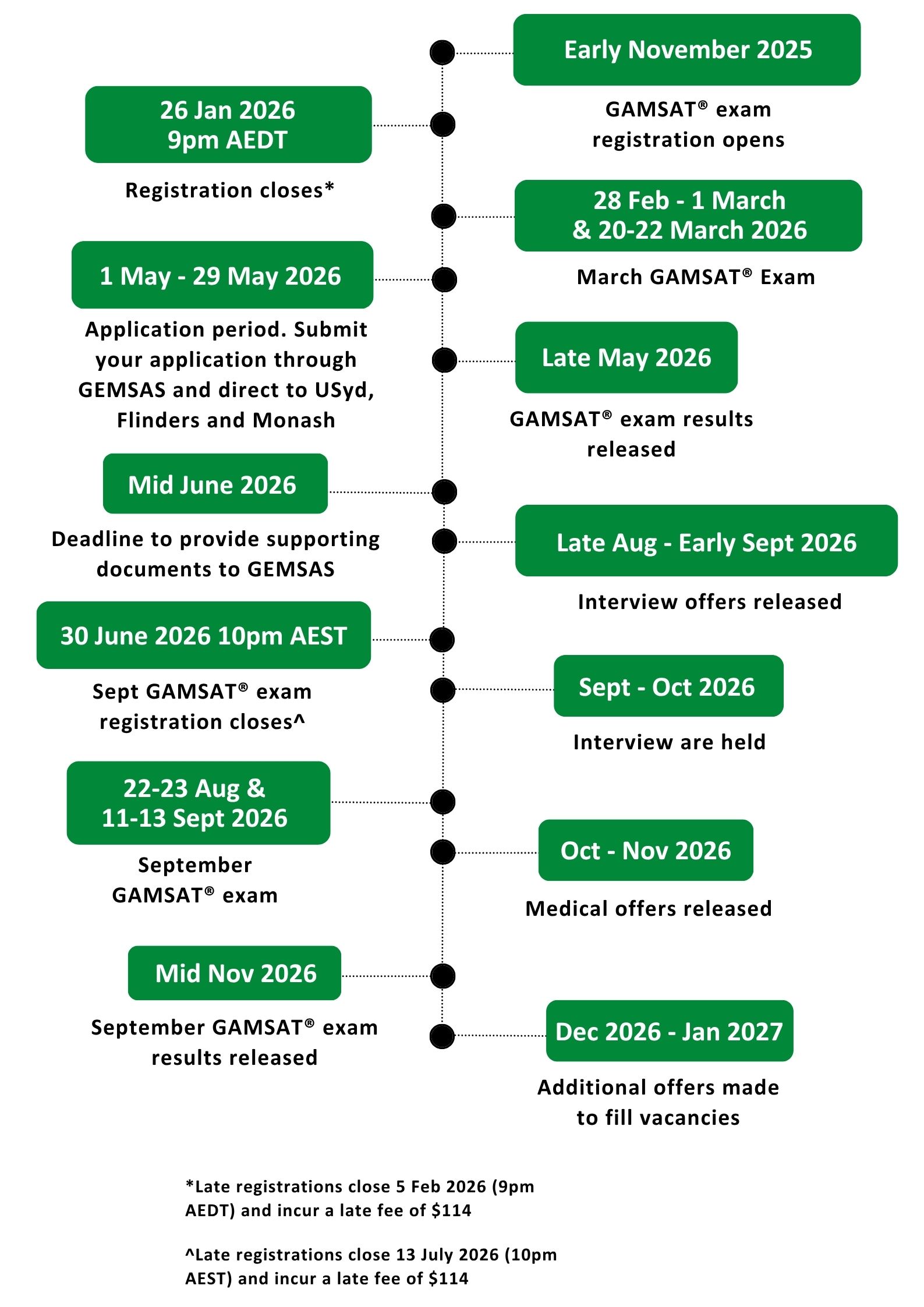
Medical Admissions Timeline 2026
Medical Applications Timeline 2026
| Medical School Application Event |
Dates |
|
Application Period. Submit your application through GEMSAS.
University of Sydney,
Flinders University
&
Monash Uni
are not part of GEMSAS
|
May 2026 |
| GAMSAT Results Released. |
Late May 2026 |
| Medical School Interview Offers Released |
Early September 2026 |
| Medical School Interviews are held |
September - October 2026 |
| Medical School Offers Released |
October - November 2026 |
| Additional Offers made to fill vacancies |
December 2026 - January 2027 |
The above timeline provides a rough guideline to important dates throughout the admissions year. Note that it is essential to check specific milestones and obtain up-to-date information from the appropriate medical institutions.
GEMSAS
publishes a comprehensive admissions guide every year, with the latest guide generally published in mid-to-late April for entry in the following year.
Check for other key dates on the GEMSAS website:
GEMSAS Key Dates
.
For non-GEMSAS medical institutions (USyd, Flinders, Monash), it is critical to review their specific timelines, as
their application deadlines differ from the GEMSAS dates
. Missing a non-GEMSAS deadline is one of the most common — and most avoidable — mistakes applicants make.
Waitlist and subsequent offers:
After the initial round of offers in late October–November, GEMSAS makes additional offers through December and into January to fill places left vacant by candidates who decline or fail to meet conditions. Although there are no official numbers published on waitlist offers, up to 10% of a medical school's cohort can be from waitlist offers each year. This applies to both GEMSAS and non-GEMSAS universities, with some offers coming as late as mid-January. If you are borderline for an initial offer, it is worth keeping your options open through the supplementary rounds.
How to Order Your GEMSAS Preferences
It's near impossible to "play the system" with GEMSAS preferencing. All offers are coordinated centrally, and if a medical school doesn't want you, you'll be passed on to your next preference for consideration. Below are some practical tips — remember, don't overthink it.
How preference cascading works:
Each applicant's eligibility and competitiveness is assessed for their number one preference first. If you don't meet the requirements or aren't ranked highly enough to gain an interview offer at your first preference, you'll be assessed for your second — then third, and so on — until an interview offer is made or all preferences are exhausted.
Post-interview cascading:
After interviews, the same cascade applies using interview scores according to each school's selection rules. However, you cannot receive an offer at a school ranked
higher
on your preference list than the school where you interviewed. For example, if you interviewed at your fourth preference, your application for a final offer will be considered for preferences four, five, and six — not one, two, or three.
Strategic advice:
It's worth reading through the
admissions criteria and weightings
to understand how each university weighs its selection criteria. You may find that your strengths align better with certain schools:
-
Strong life experience and extracurriculars?
Consider universities with admission bonuses (UoW) or percentage bonuses (Deakin) — these reward breadth beyond academics.
-
High GAMSAT ® but lower GPA?
Universities that weight GAMSAT ® more heavily — or use GPA only as a hurdle (UoW) — may give you the best chance.
-
Strong GPA but moderate GAMSAT ®?
Schools that weight GPA more heavily in their combination formula could work in your favour.
Ultimately, however,
order your preferences based on where you actually want to study and where you'll be happiest.
A medical degree requires enormous time, energy, and commitment — you need to be comfortable with your decision, especially if it involves moving interstate.
A practical three-step method for ordering your preferences:
- Rank all medical schools based on where you actually want to live, attend, and thrive.
- If you do not want to live somewhere, do not preference it.
- If you end up with more than six on the list, remove the ones where you would be least competitive.
For more detailed information on each university's strengths and campus experience, visit our
Australian Medical Schools Guide
.
Non-GEMSAS Applications (USyd & Flinders)
Three graduate-entry medical schools are not part of the GEMSAS system. If you want to apply to any of these in addition to your GEMSAS preferences, you must submit
separate, direct applications
— and critically, their
deadlines may differ from the GEMSAS timeline
.
University of Sydney
-
Applications are submitted directly via the
Sydney Student Portal
(not through GEMSAS or UAC, though UAC's Qualifications Assessment Service is used to calculate your GPA).
-
USyd only accepts GAMSAT ® results from the
past two years
— shorter than the standard four-year ACER validity. For 2026 entry, valid sittings are September 2023, March 2024, September 2024, and March 2025.
-
Offers are based on GAMSAT ® scores alone (no interview for standard applicants since 2021 entry). Each section of the GAMSAT ® is used individually to rank applicants — overall and average scores are not used.
-
GPA is used as a
minimum threshold only
and is not part of the criteria for making offers. Standard applicants require a minimum GPA of 5.0; rural applicants require 4.5 (calculated by UAC). Once above the threshold, a GPA of 5.1 and a GPA of 7.0 are on equal footing — only GAMSAT ® section scores determine ranking.
- The Dubbo MD stream offers 24 places with a personal statement required.
- Application deadlines typically fall in May–June — check USyd's admissions guide for the exact dates each year.
Flinders University
-
Applications are submitted directly to
Flinders University
through their online application system. The application fee is $160 (inc. GST), and if invited to interview there is an additional $65 fee.
- Not part of GEMSAS. GAMSAT ® results must be valid (two years for Flinders).
- Up to 75% of places are reserved for Flinders graduates, with complex sub-quotas for different entry pathways.
- Multiple entry streams including the South Australian Medical Pathway (SAMP) and Northern Territory Medical Program (NTMP) based in Darwin.
Monash University
-
Direct application to Monash — no GAMSAT ® required. Entry is based on academic record (WAM) and MMI.
- Only open to candidates who completed specific approved Bachelor's degrees at Monash University — external domestic applicants are not accepted.
Australian Graduate Entry Medical Schools
As of 2026, there are 14 medical schools in Australia that provide a Graduate Entry Medical Program, 13 of which require the GAMSAT ® exam (or the
MCAT
for international students). Monash University does not require the GAMSAT ® and is only open to students who completed an approved Bachelor's degree at Monash.
Of these 13 GAMSAT ®-requiring schools, 10 are members of the GEMSAS consortium. The University of Sydney and Flinders University are not part of
GEMSAS
but still require the GAMSAT ®, along with separate, direct applications.
Check out our
Australian Medical Schools Guide
for detailed information about each medical school's campus, curriculum, and culture.
GAMSAT ®-Required Medical Schools
GAMSAT ®-Required Dental & Optometry Courses
The GAMSAT ® is also required for the following non-medical graduate-entry courses:
University of Western Australia
Monash University (No GAMSAT ® Required)
Monash University removed the GAMSAT ® as an admissions criterion from 2017 onwards.
Importantly, domestic applicants for the Graduate Entry Medical Program at Monash must have completed one of the approved Bachelor's degrees at Monash University
— external domestic applicants are no longer accepted.
Entry is assessed on two factors:
- Academic Record (WAM)
- MMI (Multi-Mini Interview)
Accepted degrees include:
- Bachelor of Biomedical Science (including double degrees)
- Bachelor of Pharmacy (Honours)
- Bachelor of Physiotherapy (Honours)
- Bachelor of Science (dependent on completion of designated units)
The Bachelor of Biomedical Science (Gippsland Partnership Program) from Federation University is also accepted.
For more details, visit the
Monash University Medical School website
.
GAMSAT Score Cutoffs - Is my GAMSAT Score Good Enough?
There are currently 14 Medical Schools that provide a Graduate Entry Medical Program, 12 of which require a GAMSAT ® score (or
MCAT ® Score
for international students).
To get a list of these schools and learn more about admissions requirements, visit our overview of the Medical School Applications:
Australian Medical Schools - Graduate Entry Medicine.
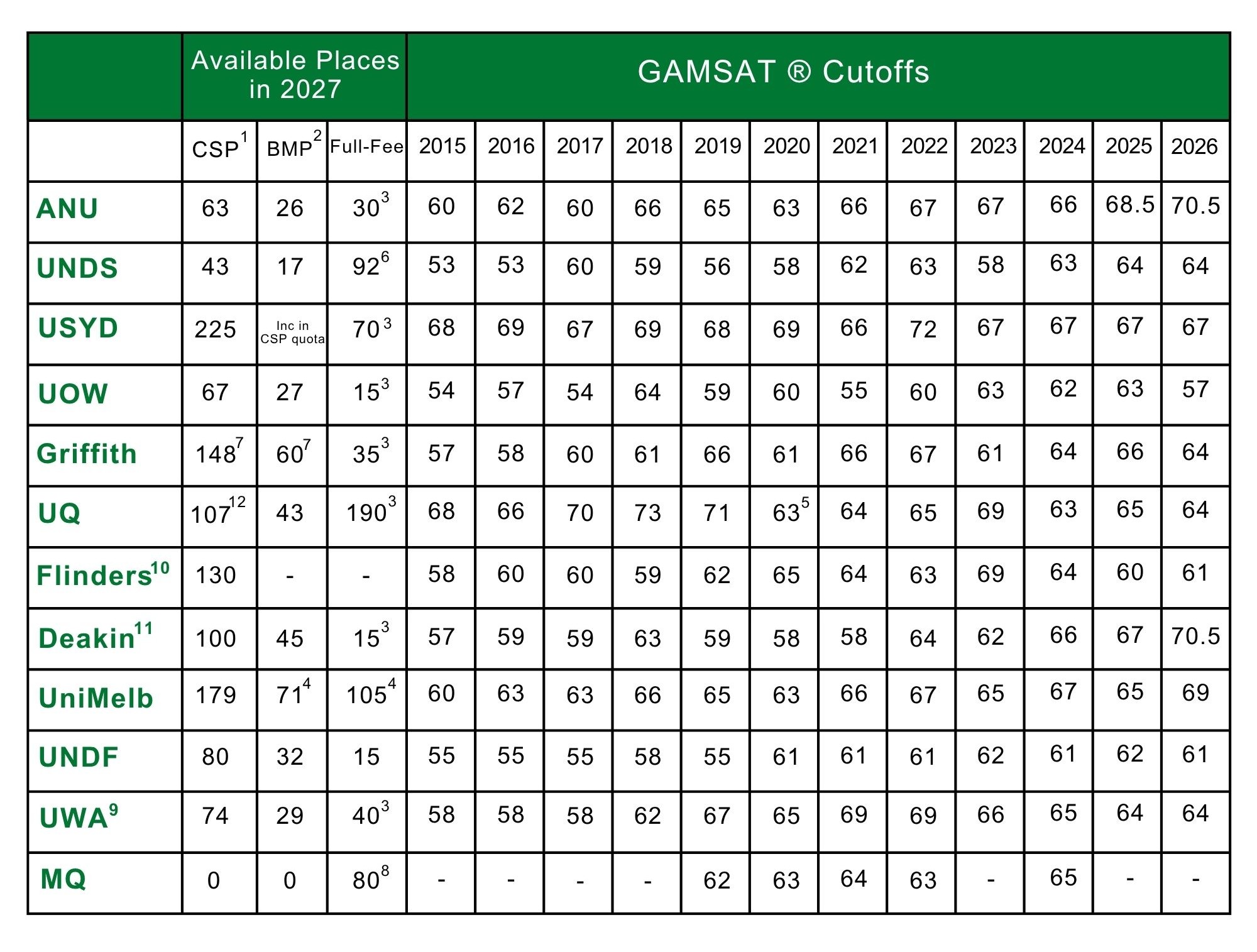
To get an idea of the GAMSAT ® score required for acceptance at different medical schools, check out the table below.
GAMSAT Cutoffs - Australian Graduate Entry Medical Schools
Note: Although some universities release official GAMSAT ® average and minimum scores for each year, the majority do not. As such, this data is based on a combination of officially available information and information collated from forums such as Reddit. Unless indicated otherwise, the scores below relate to CSP places and exclude rural and sub-quota places.
-
1CSP - Commonwealth Supported Place
2BMP - Bonded Medical Place. Click
here
to learn more.
3These full-fee places are allocated to International students only and are not applicable for domestic students. Around 24 USYD CSPs are “Dubbo Commonwealth Supported Places”. Around 30 USYD places are reserved for undergraduate Double Degree medicine students.
4For the University of Melbourne, full fee places are available to both international and domestic applicants. The University of Melbourne does not specifiy how many places go to domestic vs international students. These full-fee places are also available for Guaranteed Entry Students. Regarding the BMP places, around 30 are reserved for the MD Rural Pathway Applicants who apply outside of GEMSAS.
5In 2019, UQ introduced the MMI as part of their admissions process which may help explain the drop in cutoff scores. Prior to this, the GAMSAT ® Score was the only criteria UQ used to rank students for medical offers.
6At UNDS, approximately 30 of the full-fee places are open to International applicants.
7At Griffith, the total CSP and BMP places also include reserved places for approximately 80 students from their Medical Science Pathway
8MQ report around 20 of these 80 FFP places are for International students
9Approx 30% places are available for rural students, and up to 10% for Indigenous students
10This includes CSP and BMPs. Note that up to 75% of places available are reserved for Flinders University Graduates. For 2023 entry, 73% of places went to Flinders University Graduates. The types of places at Flinders University are complex and it is recommended students carefully read the Flinders University Medical Admissions Guide. The scores provided as a cut-off for Flinders refers to non-reserved places for Flinders Graduates.
11Scores provided for Deakin University do not include bonuses. The lowest cutoff score with Deakin bonuses was 60.75 (12% bonus)
12UQ also provides approximately 135 places for its provisional cohort which refers to an undergraduate pathway at UQ where students are guaranteed a place in postgraduate medicine as long as they complete their bachelor’s degree at UQ and achieve certain academic requirements. 40 of these places are BMP. 96 UQ CSPs are allocated to the “Wide Bay cohort” and 39 CSPs are allocated to the “Darling Downs cohort” (rural training scheme)
Note that USyd will rank students by
each section of the GAMSAT ® exam.
This means that USyd will not look at overall or average GAMSAT ® scores in the ranking of applicants. It’s important to note as well that the exact method used to combine and rank students has not been provided. Students must still meet a minimum score of 50 in each section (except for Aboriginal and Torres Strait Islander applicants). For the GPA, standard applicants will be required to have a minimum of 5, and rural applicants a minimum of 4.5. USyd have now released a
2026 Admissions Guide
and you can find a summary of the changes on our guide here:
Australian Medical Admissions Guide.
It's important to note that your GAMSAT ® Score only makes up one component of your application, and there are various other factors that need to be considered. For more information, you can refer to our guide on the different Admissions Criteria and Weightings for graduate entry medical schools around Australia:
Australian Medical Schools: Entry Requirements.
As always, it’s best to get in contact with the relevant medical institutions for further details - The above table is meant to serve as a guide and does not replace the personal responsibility of each applicant to obtain up-to-date and objective information from medical institutions regarding their medical school applications.
GAMSAT ® Score Requirements for Graduate Entry Medicine
Understanding how GAMSAT ® scores factor into admissions is essential for assessing your competitiveness.
How GAMSAT ® Scores Are Calculated & Used by Universities
The standard ACER weighting formula for the overall GAMSAT ® score is:
Overall Score = (Section 1 × 1 + Section 2 × 1 + Section 3 × 2) ÷ 4
This means Section 3 (Reasoning in Biological and Physical Sciences) contributes twice as much to the standard overall score as either Section 1 or Section 2.
However, not all universities use this standard weighting. Several universities use an unweighted (equal) average of all three sections instead:
-
Unweighted GAMSAT ® (equal sections):
UniMelb, UQ, UNDS, UNDF
-
Standard ACER weighting (Section 3 double-weighted):
ANU, Deakin, UoW, Griffith, UWA, MQ, Flinders
-
Individual section ranking:
USyd uses each section of the GAMSAT ® individually to rank applicants — neither overall nor average scores are used. While USyd does not disclose the exact method for combining section scores, observations from recent admissions cycles suggest that they weight Sections 1 and 2 more heavily relative to Section 3 than the standard formula — possibly to compensate for the removal of interviews.
For more information on how GAMSAT ® scores work, visit our guide to
understanding your GAMSAT ® results
.
Currency of GAMSAT ® Results
| Application Details |
Valid Results |
| Apply 2026 for 2027 Commencement |
March GAMSAT ®: 2023, 2024, 2025, 2026
September GAMSAT ®: 2022, 2023, 2024, 2025
|
| Apply 2027 for 2028 Commencement |
March GAMSAT ®: 2024, 2025, 2026, 2027
September GAMSAT ®: 2023, 2024, 2025, 2026
|
| Apply 2028 for 2029 Commencement |
March GAMSAT ®: 2025, 2026, 2027, 2028
September GAMSAT ®: 2024, 2025, 2026, 2027
|
Results from a September Sitting cannot be used for an application in that same year for commencement in the subsequent year. For example, if you sit the September 2026 GAMSAT ® Exam, you will be able to use the results of this exam for application in 2027 for a program commencing in 2028, for application in 2028 for a program starting in 2029, for application in 2029 for a program starting in 2030, and for application in 2030 for a program starting in 2031. You won't be able to use this result for an application in 2026 for 2027 entry. This is because medical school applications, which require submission of GAMSAT ® scores, start around May with offers for interviews being made from August to September.
In November 2022, ACER announced that your GAMSAT ® results are now valid for four years. Previously, results were only valid for two years. This change is backdated, so GAMSAT ® exam results from September 2022 can be used for medical schools application in 2026 with a 2027 start.
Note that the above information is specific to Australian universities and the details may differ, particularly for students based in the UK. To learn more about sitting the GAMSAT ® Exam this year,
read the ACER Admissions Guide.
To learn more about how GAMSAT ® Scores are actually calculated, visit our guide:
Understanding your GAMSAT ® Scores.
To learn more about applying for Graduate Entry Medical Schools in Australia and the different admissions criteria and weightings, visit our guide:
Australian Medical Schools - Entry Requirements.
Key exception — University of Sydney:
USyd only accepts GAMSAT ® results from the
past two years
, contrary to the four-year ACER validity. For 2026 entry, valid sittings are September 2023, March 2024, September 2024, and March 2025. This shorter window is a critical consideration if USyd is one of your preferred schools.
Key exception — Flinders University:
Flinders also applies a two-year validity window for GAMSAT ® results.
GAMSAT ® & GPA Combination Score — How to Estimate Your Competitiveness
The majority of GEMSAS schools use a combination of your GPA and GAMSAT ® score to rank applicants for interview. While the exact calculation differs between schools, the following formula provides a useful rough estimate:
This formula assumes equal weighting of GPA and GAMSAT ®, which is generally the case for most schools — but always check the specific university's criteria.
Worked example:
If student John has a GPA of 6.63 and an overall GAMSAT ® score of 67, his combination score would be:
This combination score is useful as a rough guide to competitiveness but should not be treated as definitive — universities may apply different weighting methods and the combination score does not account for bonuses, rural pathways, or interview performance. Review the
criteria and weightings table
for per-university combination score cutoffs.
GPA Requirements & Calculations for Medical School in Australia
Your GPA is a score out of 7.0 calculated from your marks throughout your previous studies. Importantly, your GPA does
not
need to be derived from a science degree — excellence in any field is equally recognised. Understanding how each university calculates your GPA is critical, because differences in the formulas mean your competitiveness can vary significantly from one school to another.
How GPA Is Calculated for Graduate Entry Medicine
Most GEMSAS universities use a weighted GPA that gives more weight to your final year of study:
The weighted GPA is calculated as follows:
- GPA = [((GPA Final - 2 years) x 1) + ((GPA Final - 1 year) x 2) + (GPA Final year x 3)] / 6
-
The unweighted GPA is used by Griffith University and UWA, and is simply calculated using an average of the final 3 years of study:
- GPA = (GPA Final year - 2 years) + (GPA Final year - 1 year) + (GPA Final year) / 3
Exceptions to the standard formula:
-
Unweighted GPA (Griffith, UWA):
These universities use a simple average of the final three years of study — each year weighted equally.
-
UQ (credit-value-based):
UQ uses a unique method that weights subjects by their credit value rather than the year completed. All subjects studied while enrolled in your degree are included, whether or not they counted towards the degree.
-
UniMelb (modified weighting):
UniMelb applies its own formula: Final−2 × 1, Final−1 × 2, Final year × 2 (ratio of 1:2:2 rather than the standard 1:2:3).
For many applicants, calculating their actual GPA under each formula can be confusing. The
GEMSAS GPA Calculator
is a freely accessible tool provided by GEMSAS that can help you estimate your GPA. Further details on the calculation methodology are available
on the GEMSAS website
.
Weighted vs Unweighted GPA — Which Works in Your Favour?
Understanding the difference between weighted and unweighted GPA calculations is strategically important when choosing where to apply.
Weighted GPA
gives more weight to your final years. If your grades improved significantly over the course of your degree (a common pattern — especially for students who found their academic stride later), weighted GPA will produce a higher score than unweighted.
Unweighted GPA
treats all years equally. If your grades were consistent throughout your degree — or if your earlier years were stronger — unweighted may be more favourable.
| GPA Type |
Universities |
Favours |
| Standard weighted (1:2:3) |
ANU, UNDS, UNDF, Deakin, UoW, MQ, Flinders |
Students who improved over time |
| Modified weighted (1:2:2) |
UniMelb |
Students who improved — but slightly less benefit from final year |
| Unweighted (equal) |
Griffith, UWA |
Students with consistent grades throughout |
| Credit-value weighted |
UQ |
Depends on your credit distribution |
| GPA as hurdle only |
UoW |
Students with GPA above the minimum (5.5) — further GPA strength doesn't help ranking |
University-Specific GPA and GAMSAT ® Calculations
| University |
GPA Calculation |
GAMSAT ® Calculation |
|
ANU
|
|
Standard GEMSAS Weighting
Minimum wGPA of 5.0
|
|
Standard ACER Weighting
Minimum of 50 in each Section & Minimum Overall Score of 50
|
|
UNDS
|
|
Standard GEMSAS Weighting
Minimum wGPA of 5.2
|
|
Unweighted GAMSAT ®
Score (Average of all 3 sections)
Minimum Overall Score of 52 & Minimum of 50 in Each Section
|
|
USyd
|
|
Unweighted GPA
Minimum uwGPA of 5.0 (4.5 rural)
|
|
Each Section will be used to rank applicants - Neither overall GAMSAT ® scores or average scores will be used. Minimum of 50 in Each Section.
|
|
UoW
|
|
Standard GEMSAS Weighting
Minimum wGPA of 5.5
Only used as hurdle for interview offers
|
|
Standard ACER Weighting
Minimum of 50 in each Section & Minimum Overall Score of 50
|
|
Griffith
|
|
Unweighted GPA
Minimum uwGPA of 5.0
|
|
Standard ACER Weighting
Minimum of 50 in each Section & Minimum Overall Score of 50
|
|
UQ
|
|
Unique UQ weighted GPA (using credit value not year)
Minimum uwGPA of 5.0 or minimum WAM of 65
|
|
Unweighted GAMSAT ®
Score (Average of all 3 sections)
Minimum of 50 in each Section
|
|
Flinders
|
|
|
Standard ACER Weighted
Minimum of 50 in each Section
|
|
Deakin
|
|
Standard GEMSAS Weighting
Minimum wGPA of 5.0
|
|
Standard ACER Weighting
Minimum of 50 in each Section & Minimum Overall Score of 50
|
|
UniMelb
|
|
wGPA using the below calculation:
the final-minus-2 x 1
the final-minus-1 x 2
the final x 2
Minimum wGPA of 5.0
|
|
Unweighted GAMSAT ®
Score (Average of all 3 sections)
Minimum of 50 in each Section
|
|
UNDF
|
|
Standard GEMSAS Weighting
Minimum wGPA of 5.2
|
|
Unweighted GAMSAT ® Score (Average of all 3 sections)
Minimum Overall Score of 52 & Minimum
of 50 in Each Section
|
|
UWA
|
|
Unweighted GPA
Minimum uwGPA of 5.5
|
|
Standard ACER Weighting
Minimum of 50 in each Section & Minimum Overall Score of 55
|
|
MQ
|
|
Standard GEMSAS Weighting
Minimum wGPA of 5.0
|
|
Standard ACER Weighting
Minimum of 50 in each Section & Minimum Overall Score of 50
|
The above table breaks down how each medical school calculates your GPA and GAMSAT ® score. The process can become complex — some universities include postgraduate study, Deakin provides percentage bonuses, and specific details may change depending on a number of factors. It's highly recommended that you read through the
GEMSAS Admissions Guide
carefully as well as their
guide on GPA calculations
.
Postgraduate Studies & GPA — How Masters, PhD, and Honours Are Treated
For students who have completed postgraduate studies, understanding how each university treats higher degrees in GPA calculations can be particularly valuable — and in some cases, a postgraduate qualification can significantly boost your competitiveness.
| Postgraduate Study |
Use in GPA Calculations |
| Honours |
Most universities will use, depending on level of completion.
If completed before interview offers, will be included in GPA calculations for all universities.
If half complete, i.e. Honours Semester 1 results are out, these will be used (for some universities) together with Bachelor degree results for GPA calculation for interview offers. Some universities will only review honours results if they are complete.
If no Honours results are available before interview offers, they will only be used to confirm any conditional or provisional offer for medical school place (for most universities) - Interview offers will be based off Bachelor degree results alone.
ANU may allocate a bonus of 2% to GPA/GAMSAT marks for completion of standalone Honours only.
|
| Graduate Diplomas/Certificates |
UQ, UWA, Deakin, UNDS/UNDF, UoW, and Macquarie may use in GPA calculation - Check the specific details under each University in the GEMSAS Guide for further details.
|
| Masters by Research |
Macquarie may use in GPA calculation. It will be treated as the most recent year of study and allocated an overall GPA of 7.0
UQ may allocate a GPA of 7.0 for a completed Master of Philosophy (MPhil)
Griffith may allocate GPA of 7.0 for each year completed (up to two)
UNDF and UNDS will award bonus points. The Masters by Research will not be directly included in the GPA calculation.
UWA may allocate a 0.2 bonus to your GPA for completion. The Masters by Research will not be directly included in the GPA calculation.
ANU may allocate a bonus of 2% to GPA/GAMSAT marks for completion. The Masters by Research will not be directly included in the GPA calculation.
The University of Melbourne will calculate GPA based on the applicant's undergraduate coursework studies but may adjust the GPA in the applicant's favour for applicants with a completed PhD or Masters qualification in a related discipline (strict quotas apply).
|
| Masters by Coursework |
UQ, UWA, ANU, Deakin, Griffith, UNDS/UNDF, UoW, and Macquarie may use in GPA calculation
The University of Melbourne will calculate GPA based on the applicant's undergraduate coursework studies but may adjust the GPA in the applicant's favour for applicants with a completed PhD or Masters qualification in a related discipline (strict quotas apply).
UWA applicants who have completed a Doctor of Dental Medicine from UWA will be awarded a GPA of 7.0.
|
| PhDs |
Macquarie may use in GPA calculation. It will be treated as the most recent year of study and allocated an overall GPA of 7.0
If completed, Griffith, UWA, and UQ may allocate overall GPA of 7.0
ANU may allocate a bonus of 4% to GPA/GAMSAT marks for completion
UNDF and UNDS will award bonus points
The University of Melbourne will calculate GPA based on the applicant's undergraduate coursework studies but may adjust the GPA in the applicant's favour for applicants with a completed PhD or Masters qualification in a related discipline (strict quotas apply).
|
Non-GEMSAS schools and postgraduate study:
-
University of Sydney:
GPA is calculated from your Bachelor's degree only. However, a postgraduate qualification (at least one year FTE) completed within the past 10 years can extend your eligibility if your Bachelor's degree was completed more than 10 years ago. Masters and PhD studies are not directly included in the GPA calculation.
-
Flinders University:
GPA is calculated as a weighted GPA based on the past three FTE years of your most recent Bachelor's degree. Masters and research higher degrees are not included in the wGPA calculation, though Flinders notes they "may provide you with valuable experience that could help your interview performance."
Important note for postgraduate applicants:
While a PhD or Masters by Research can significantly boost your GPA at some GEMSAS universities (e.g. automatic GPA of 7.0 at Macquarie, Griffith, UQ for completed PhDs), the benefit varies widely. Some universities only award bonus points rather than incorporating the degree into the GPA calculation, and others don't consider postgraduate study at all. The decision to pursue postgraduate study solely for GPA improvement should be weighed carefully against the time investment. Check the GEMSAS guide and individual university requirements before making this decision.
What GPA Do You Actually Need for Medical School in Australia?
While the official minimum GPA for most graduate-entry medical schools is around
5.0–5.5 on a 7-point scale
, the truth is that competitive GPAs are significantly higher. Medicine is one of the most competitive courses in Australia, and the actual GPA needed for an interview offer is typically well above the published minimum.
As a general guide, competitive GPAs tend to be
6.0 and above
for most schools, with the most competitive universities often requiring GPAs of 6.5+. However, these figures vary year to year and depend heavily on the combination of your GAMSAT ® score, the university's specific weighting formula, and other factors.
An important nuance:
Some schools — notably the University of Sydney — do not use GPA as a ranking factor at all for standard applicants. USyd uses GPA only as a
threshold
(minimum 5.0, or 4.5 for rural applicants), with ranking determined entirely by GAMSAT ® section scores. This means students with a GPA just above the threshold are on equal footing with those at 7.0, provided their GAMSAT ® scores are strong. Similarly, the University of Wollongong uses GPA only as a qualifying hurdle — once you meet the minimum (5.5), your GPA doesn't contribute to your interview or offer ranking.
Read our article
How Does GEMSAS Interpret Your GPA?
for a deeper look at what competitive GPAs look like in practice.
COVID-19 GPA Adjustments
The COVID-19 pandemic caused significant disruptions to university grading in 2020, with many institutions moving to pass/fail models. This had ramifications for GPA calculations for applicants whose qualifying degrees included 2020 study.
Most university policies have now converged back to treating 2020 results as shown on transcripts. For example, UWA — which initially treated all Semester 1 2020 results as ungraded pass/fail — has now reverted to including these results as they appear on the transcript.
If your qualifying degree included study in 2020
, check the latest
GEMSAS Admissions Guide
for how your specific university of choice handles these results. Some specific policies still in effect include Griffith University's mechanism allowing applicants to request that all Semester 1 2020 grades be disregarded.
For the majority of current applicants — particularly those who completed their degrees after 2020 — these adjustments are unlikely to be relevant. However, if you're affected, the GEMSAS guide provides the definitive current position for each university.
Admissions Criteria & Weightings — How Each University Selects Students
This is the heart of the admissions comparison — how each of Australia's graduate-entry medical schools weighs GAMSAT ® scores, GPA, interviews, and other criteria when selecting students.
Key Changes for 2027 Graduate Medicine Admissions
The most significant admissions changes for the current cycle, organised by impact:
Scoring & weighting changes (highest impact on applicants)
-
UWA
now uses revised weightings: 30% GPA, 20% GAMSAT ®, 50% interview (previously equal thirds). Rural applicants are weighted differently: 22.5% GPA, 15% GAMSAT ®, 37.5% interview, 25% rural rating.
-
UoW
has replaced the portfolio with Admission Bonuses. Interview ranking is now based on Casper (50%) + bonuses (50%), and offer ranking on interview (70%) + bonuses (30%).
-
UNDS/UNDF
now use specific published weightings: Interview offers = 30% GAMSAT ® + 30% GPA + 30% Casper + 10% bonuses. Final offers = 50% combined score + 50% MMI.
Application process changes
-
UNDS/UNDF
replaced the portfolio with Casper from 2024 onwards.
-
Macquarie
requires a compulsory personal statement graded as satisfactory/unsatisfactory.
Rural pathway developments
-
Deakin Rural Training Stream
continues with 30 places and a three-tier priority system (Tier 1: Deakin's rural footprint — no GAMSAT ® required; Tier 2: MM2–7 Rural Victoria; Tier 3: MM2–7 other rural Australia).
-
UQ Regional Medical Pathway
offers up to 90 places across Central Queensland–Wide Bay and Darling Downs–South West regions.
-
UniMelb MD Rural Pathway
offers 30 places (15 for La Trobe graduates, 15 open).
-
UNDF Kimberley Centre for Remote Medical Training (KCRMT)
commenced in 2025 as an end-to-end rural graduate medical training pathway based at Notre Dame's Broome Campus.
Other changes
-
USyd
continues without interviews for standard applicants, ranking by individual GAMSAT ® section scores. The Dubbo MD stream (24 places) requires a personal statement.
-
Griffith
provisional entry (for BMedSc students) now requires GPA of 5.5. UCAT is used for second-order ranking within ATAR band for provisional entry.
-
Rurality classification:
GEMSAS uses the Modified Monash Model (MMM) for all rural background assessments. Applicants need 5 years consecutive or 10 cumulative years in MM2–7 areas. Use the
Health Workforce Locator tool
(select Modified Monash Model 2019) to check your classification.
-
UQ prerequisites:
Integrative Cell & Tissue Biology and System Physiology remain required since 2023 entry. Check
UQ's prerequisites list
for equivalent subjects at other institutions.
-
UniMelb:
COVID-impacted grades require a manual request for inclusion. Prerequisites removed from 2022 entry onwards.
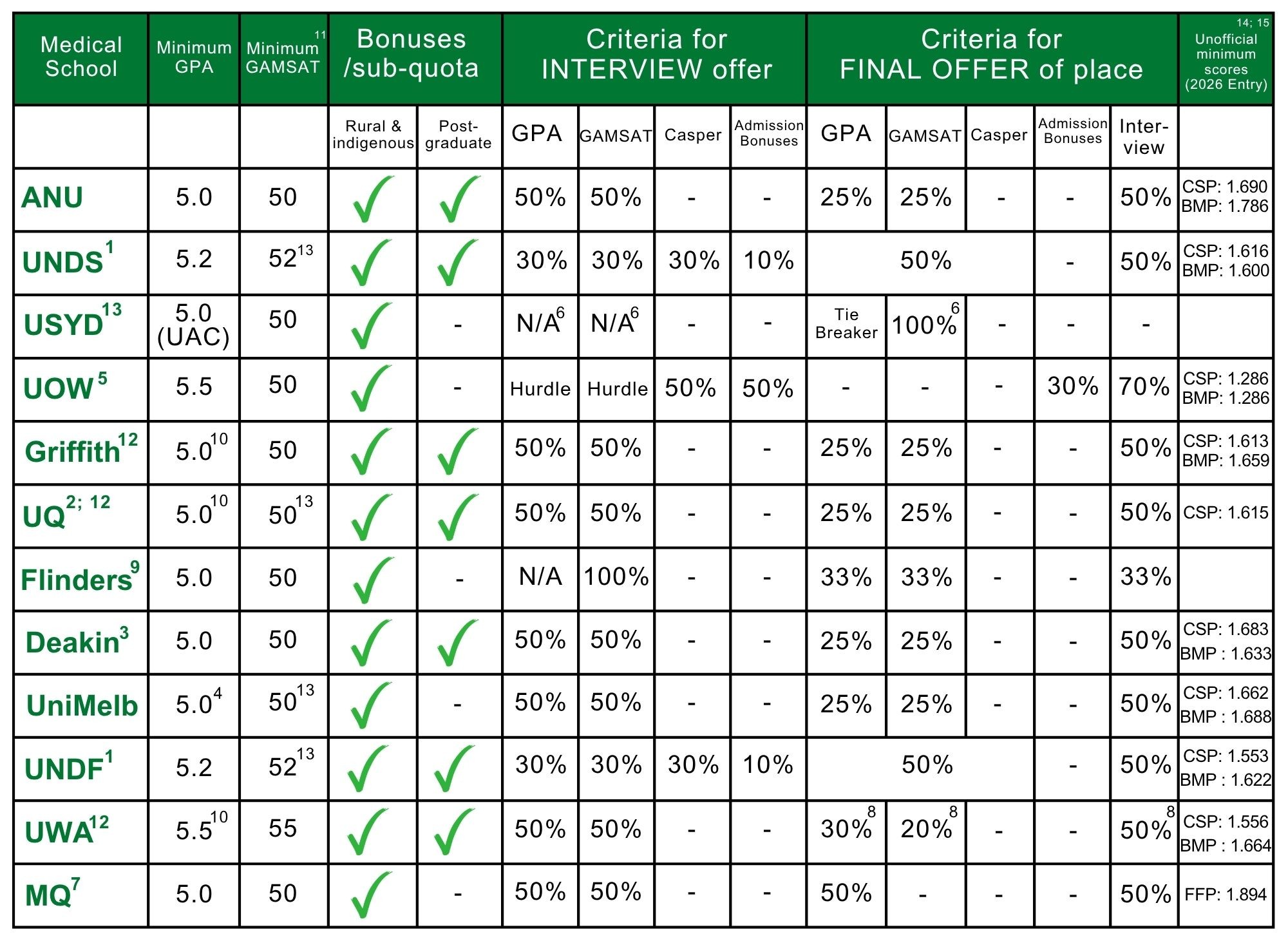
Per-University Criteria & Weightings
-
1For the interview offers, UNDF/UNDS allocates 10% of the weighting to bonus points for rurality, completion of Higher Degrees by Research, and WA residency (UNDF only). For the medical school place offer, students are ranked by a combination of the GAMSAT ®, GPA, Casper and bonus points (50%) and interview (50%).
2Prerequisites apply (check the
UQ website
for more information). UQ uses GPA as a tiebreaker for interview offers, and MMI Score as a tiebreaker for medical school offers where necessary.
3Deakin offers a Rural Training Stream for which the criteria and weightings differ from the General Stream.
4The University of Melbourne calculates GPA according to the following ratio - (Final Year-2: Final Year-1: Final Year) : (1:2:2)
5The University of Wollongong uses GPA as a qualifying hurdle for interview offers. GPA scores will not be used in ranking for interviews or places offers once the hurdle has been met.
6Contrary to changes made by ACER, USyd will only accept GAMSAT test results obtained in the past two years. The GAMSAT scores alone are used to rank students for offers.
7MQ have a compulsory personal statement that must be submitted with application and will be graded as satisfactory or unsatisfactory for interview offers
8UWA applies a different weighting for rural applicants: 22.5% to GPA, 15% to GAMSAT score, 37.5% to interview score, and 25% to rural rating.
9Flinders requires a Flinders equivalent GPA of 5.0 and a minimum score of 50 in each section of the GAMSAT to apply.
10A GPA of 7 is awarded to masters by research and PhD studies (NB: UWA awards this for PhDs only)
11Overall minimum scores are listed, but all universities also require a minimum section score of 50 in each section (discretionary for UNDS/UNDF).
12Griffith University & UWA use unweighted GPA Scores. UQ uses a unique method to calculate the GPA based on credit value rather than the year in which the subject was completed. Griffith & UQ convert the GPA to a percentage.
13UniMelb, UQ, UNDS & UNDF use an unweighted GAMSAT Score - Each section of the GAMSAT Exam is weighted equally.
14Unofficial minimum scores drawn from self-reported scores in the PagingDr forum (
pagingdr.net
). In most instances, the scores listed ignore bonuses (rural etc.), but some scores may include such bonuses and may be for bonded or full-fee place types and will be marked accordingly. Many medical schools do not publish official cut-off scores so these should be used as a guide only.
15Some scores listed here are derived by combining GAMSAT/GPA score (GPA/7 + GAMSAT/100) which is roughly used to rank applicants.
16These scores includes rural and other bonuses
CSP - Commonwealth Supported Place.
BMP - Bonded Medical Place. For more details see
here.
UAC - University Admissions Centre. For more details visit the
USyd Website
or the
UAC site.
Additional Criteria & Requirements Beyond GAMSAT ® and GPA
Beyond GAMSAT ® scores and GPA, several universities consider additional criteria. It's essential to check with each institution for up-to-date details:
|
All universities
|
- May have sub-quotas or bonuses for rural, Indigenous and Torres Strait Islander and previous healthcare applicants. Many universities have dedicated Indigenous entry pathways that may waive the GAMSAT ® requirement. Rurality is determined using the Modified Monash Model system.
|
|
USyd
|
-
Assumed knowledge in physiology, anatomy, and molecular/cellular biology (
not prerequisites
— a Foundation Knowledge Course is accessible online to all enrolled students).
|
|
UniMelb
|
- Prerequisites were removed from 2022 entry onwards. Students with limited prior learning in enabling biosciences are encouraged to select discovery pathway options that address these areas, supported by Learning Advisors. No formal assumed knowledge requirements.
|
|
UQ
|
-
Prerequisites:
Integrative Cell & Tissue Biology & System Physiology.
UQ provides a list of equivalent subjects at different institutions
on their website.
If you come from a non-science background and need to prepare for
GAMSAT ® Section 3
, these prerequisites can double as useful preparation.
|
|
Flinders
|
- Up to 75% of places reserved for Flinders graduates. Complex sub-quotas for different entry pathways.
|
|
Deakin
|
Deakin offers various percentage bonuses to the combined GPA/GAMSAT ® score:
- Rural/Regional Applicants: 4–8% bonus
- Prior Clinical Experience: 4% bonus
- Prior Work Experience: 2% bonus
- Financial Disadvantage: 2% bonus
- Deakin Study Bonus: 4% bonus
|
|
UoW
|
|
|
Macquarie
|
- Compulsory personal statement (graded satisfactory/unsatisfactory). 3% GPA bonus for Indigenous, rural, and Macquarie BClinSci applicants (5% maximum for multiple cohorts).
|
|
UNDS/UNDF
|
- Bonuses for rurality, HDR completion, and WA residency (UNDF only). Casper test required.
|
Admission Bonuses — UoW's Detailed System
The University of Wollongong is the only graduate-entry medical school in Australia that includes a formal admission bonuses system. These bonuses reflect the principles valued in the MD program — namely an emphasis on and commitment to rural healthcare.
The bonuses are equally weighted, cumulative, and are used in two stages of the admissions process:
-
Interview ranking:
Combination of Casper score (50%) and bonuses (50%)
-
Offer ranking:
Combination of interview score (70%) and bonuses (30%)
|
Bonus 1 - UoW First preference Applicant
|
Applicants who choose UoW as their GEMSAS first preference will be eligible for this bonus.
|
|
Bonus 2 - Registered Health Professionals
|
Current health professionals with unconditional registration with one of the following*:
|
|
Bonus 3 - Service Commitment
|
Applicants participating in:
- Active volunteering services (2+ years)
- State and national emergency services or military services (2+ full-time years)
|
|
Bonus 4 - Full-time work experience
|
Applicants with:
- Full-time paid employment in any industry (2+ years)
|
|
Bonus 5 - Rural work experience
|
Applicants with:
- Full-time paid employment while living in a rural area (MM2-7) in any industry (2 years at 25 hours per week over three years)
|
|
Bonus 6 - Rural High School Education
|
Applicants with:
- 4+ years of schooling in a MM2-7 rural area
|
|
Bonus 7 - Illawarra Local Resident MM1
|
Applicants currently living in MM1 Wollongong area (must have resided in the area for 5+ years immediately prior to application)
|
|
Bonus 8 - NSW Rural Resident MM2-7
|
Applicants who:
- Resided in rural NSW (MM2-7) for 5+ consecutive years (or 10 cumulative)
|
|
Bonus 9 - UoW Graduate
|
Applicants with:
- 3 FTE of undergraduate study at UoW OR
- 1.5 FTE of postgraduate study at UoW
|
|
Bonus 10 - UoW Graduate + Academic Excellence
|
Applicants with:
- Bonus 9 PLUS an overall weighted GPA of 6.5
|
|
Bonus 11 - Indigenous Health Graduate
|
Applicants with:
- Postgraduate qualifications in Indigenous Health from an Australian university OR Maori Health qualification from Aotearoa New Zealand
|
*AHPRA – Australian Health Practitioner Regulation Agency, DA – Dietitians Australia, SPA – Speech Pathology Australia, ESSA – Exercise and Sport Science Australia
In addition to UoW's formal system, Deakin University offers percentage bonuses (Rural/Regional 4–8%, Prior Clinical Experience 4%, Prior Work Experience 2%, Financial Disadvantage 2%, Deakin Study 4%) that are applied to the combined GPA/GAMSAT ® score. Refer to the
GEMSAS Admissions Guide
for full details on Deakin's bonuses.
Medical School Interviews — Formats and What to Expect
Interviews are a critical component of the admissions process for most graduate-entry medical schools. At the majority of universities, the interview contributes approximately
50% of your final offer score
— meaning even a strong GAMSAT ® and GPA can be undone by a poor interview (and a strong interview can elevate a borderline application).
Interview Formats by University
The table below summarises the interview format used by each university. Specific dates change annually — always check the latest
GEMSAS Admissions Guide
and individual university websites for current dates.
| University |
Interview Details |
|
ANU
|
Interviews are typically held in two parts in September each year. All interviews are held online and there is no requirement to be in Canberra.
|
|
UNDS
|
Approximately 300 applicants will be interviewed for 120 places. The interview is an online Multi-Mini Interview (MMI). Interview offers are typically made in September.
|
|
USyd
|
Interviews are no longer part of the standard criteria. Offers are based on GAMSAT ® scores alone. Should applicants be ranked equally, the University reserves the right to use an additional selection tool such as an interview or Situational Judgement Test (SJT).
|
|
UoW
|
Online MMI format held in late September 2026. Interviewees are assessed on communication skills, empathy, ethics, teamwork, and decision-making.
|
|
Griffith
|
The GUMSAA (multi-station) assessment is scenario-based and held online in late September 2026.
|
|
UQ
|
MMI via videoconference in September 2026. Applicants must book directly with UQ by the booking due date.
|
|
Flinders
|
Semi-structured interview. In-person for SA/NT residents; online for interstate applicants.
|
|
Deakin
|
A maximum of 220 applicants interviewed for 136 places. Online MMI format (6 stations × 5 minutes) held in September 2026.
|
|
UniMelb
|
MMI (8 stations × 5 minutes) assessing non-academic qualities including cultural sensitivity, maturity, collaboration, reliability, and communication skills.
|
|
UNDF
|
Approximately 200–250 applicants interviewed for 100 places. Online MMI format. Interview offers typically made in September.
|
|
UWA
|
Structured interview held in-person in Perth, late September–October. Applicants must attend in Perth.
|
|
MQ
|
MMI format. Domestic applicants attend face-to-face; international applicants via video.
|
Check out our
Guide to Medicine MMIs: Multiple Mini-Interviews
for detailed preparation strategies.
How to Prepare for Medical School MMIs and Interviews
The interview is where months of preparation come together — and it's one of the few parts of the application that you can actively improve in a relatively short time. Most universities weight the interview at roughly 50% of the final offer, making it arguably the most decisive single component.
Interview formats vary (MMI, structured, multi-station scenario-based), and each university assesses different qualities — but communication skills, ethical reasoning, empathy, and the ability to think on your feet under pressure are universally valued.
Our
Guide to MMIs
covers preparation strategies in detail. For structured, university-specific preparation,
InterviewReady courses
offer tailored mock interviews and feedback with a 90% medical school admission rate among participants.
How Competitive Is Graduate Medicine in Australia?
There's no sugarcoating it — getting into graduate medical school in Australia is hard and competitive. The application process is long and requires you to excel across multiple dimensions: GPA, GAMSAT ®, and (for most schools) a high-stakes interview. But understanding the competition puts you in a better position to make strategic decisions.
Acceptance Rates & Applicant Numbers
While exact applicant numbers are not officially published, estimates suggest that over
10,000 applicants
compete for approximately
2,000 graduate-entry places
across Australia each year — a ratio of roughly 5:1.
This ratio varies significantly by university. Schools with fewer places (such as UWA with approximately 103 domestic places, or Macquarie with around 80) tend to have steeper competition, while others (such as UQ with up to 90 regional pathway places in addition to standard places) may offer somewhat more accessible entry through specific pathways.
The key takeaway: don't neglect any aspect of your application. GAMSAT ®, GPA, and interview performance all matter — and at most universities, the interview alone contributes 50% of your final score. Give everything your best effort, approach the process strategically, and trust that the investment is worth it. Even though the
pathway to medicine
can be long and challenging, there are many options — so don't give up.
What If I Have a Low GPA? Options for Graduate Entry Medicine
A lower GPA doesn't necessarily mean medicine is out of reach. Here are practical strategies based on how the admissions system actually works:
-
Check your actual GPA under each formula.
Different universities calculate your GPA differently — you may be more competitive at some schools than you think. Use the
GEMSAS GPA Calculator
.
-
Target universities that use GPA as a hurdle.
UoW only uses GPA as a qualifying threshold (5.5) — once met, your GPA doesn't affect your ranking. USyd also uses GPA as a threshold (5.0 standard, 4.5 rural) with ranking based entirely on GAMSAT ® scores.
-
Leverage weighted GPA if your grades improved.
If your final year was your strongest, schools using the standard weighted formula (1:2:3) will give you credit for that improvement.
-
Consider postgraduate study.
Some universities award automatic GPA of 7.0 for completed PhDs (Macquarie, Griffith, UQ) or bonus points (ANU: 4%, UNDS/UNDF: bonus points, UWA: 0.2 GPA bonus). A Masters or PhD can meaningfully shift your competitiveness — though the time investment is significant.
-
Explore rural and Indigenous pathways.
Many schools lower or waive GPA requirements for Aboriginal and Torres Strait Islander applicants and/or students from rural backgrounds.
Read our detailed guide:
What are my options for studying medicine if I have a low GPA?
Retaking the GAMSAT ® — What to Know About Sitting Again
The competitive nature of graduate medicine admissions means that retaking the GAMSAT ® is extremely common. In fact,
most students who eventually gain entry sit the GAMSAT ® at least twice
, with many sitting it three or more times before achieving a competitive score.
Key points about resitting:
-
There is no limit
on the number of times you can sit the GAMSAT ®.
-
The exam is offered
twice a year
— in March and September — giving you two opportunities annually.
-
GAMSAT ® scores are valid for four years
(two years for USyd and Flinders), so a previous good score is not lost when you resit.
-
Each sitting is a
fresh opportunity
— your best score from any valid sitting will typically be used.
Needing to resit the GAMSAT ® is in no way a reflection of whether you will become a competent doctor. The exam is one hurdle in a long process, and the persistence required to resit and improve is itself a quality that serves medical students and doctors well throughout their careers.
It can be emotionally difficult to return to the GAMSAT ® after a disappointing result, but students who resit have genuine advantages: they know the exam format, have a better sense of high-yield study areas, and often study more strategically the second time around.
Read our guide on
how to prepare for the GAMSAT ®
to optimise your study, and consider setting up a structured
GAMSAT ® study schedule
to maximise your score improvement.
Which University Is Easiest to Get Into for Graduate Medicine?
There is no single "easiest" medical school to get into. As the criteria and weightings table above shows, each university has different selection rules — and depending on your specific strengths, some schools will suit you better than others.
Here's how to think about it strategically:
-
High GAMSAT ®, lower GPA?
→ USyd (GAMSAT ® only, GPA as threshold), UoW (GPA as hurdle only — once met, it doesn't affect ranking)
-
Lower GAMSAT ®, strong GPA?
→ Schools that weight GPA more heavily in the combination formula
-
Strong life experience and extracurriculars?
→ UoW (11 admission bonuses), Deakin (percentage bonuses for clinical/work experience, rural background)
-
Rural background?
→ Most schools have dedicated rural sub-quotas with lower cutoffs. Deakin's Rural Training Stream Tier 1 doesn't require a GAMSAT ® score at all. UniMelb's MD Rural Pathway offers 30 places. UQ's Regional Medical Pathway offers up to 90 places.
-
Completed a PhD?
→ Macquarie, Griffith, and UQ award automatic GPA of 7.0 for completed PhDs — a major advantage if your undergraduate GPA was lower.
The bottom line: rather than asking "which school is easiest?", ask "which school's selection criteria best match my strengths?" — and preference accordingly.
The Cost of Applying to Graduate Medical School in Australia
Applying for graduate entry medicine involves several costs that add up quickly. Understanding these upfront helps you budget for the application process.
-
GAMSAT ® registration:
AUD $568 per sitting (standard registration). Late registration incurs an additional $114 fee. Since most students sit the GAMSAT ® at least twice, budget for at least $1,136 in exam fees alone.
-
GEMSAS application fee:
Approximately $275, which covers all six preference choices.
-
Non-GEMSAS application fees:
Flinders University charges $160 (inc. GST) plus $65 if invited to interview. Check USyd's admissions guide for their current application fee.
-
Casper test fee:
If applying to schools that require Casper (UNDS, UNDF, UoW), check the
Acuity Insights website
for current pricing.
-
GPA calculation (USyd):
USyd requires GPA calculation through UAC's Qualifications Assessment Service (QAS) — the fee is $155 (inc. GST). The service reopens annually in April and typically takes one to two weeks to process.
-
Document certification:
GEMSAS may require certified copies of documents. JP certification is free in most Australian states, but statutory declarations or notarised copies through a solicitor can cost $20–$50 per document.
-
Interview travel costs:
While most interviews are now conducted online, some universities (UWA, Flinders for SA/NT residents) conduct in-person interviews. Travel to Perth or Adelaide can cost $300–$1,000+ depending on your location.
Estimated total (one application cycle, GEMSAS + one non-GEMSAS school):
$1,000–$2,500+ depending on how many times you've sat the GAMSAT ® and whether in-person interviews are required.
Australian Medical School Fee Types
There are three main types of medical student ‘places’ in Australia available to domestic students:
-
Commonwealth Supported Places (CSPs)
-
Bonded Medical Places (BMPs)
-
Full-Fee Paying Places (FFPs)
The table below summarises what each means and who may be eligible. Further down this page, we will go through how many positions for each type are accepted by each university, as of 2026. It is important to stress however that students should always check with the universities and the GEMSAS guide for the most up-to-date information regarding the numbers and requirements for each type of place. There are other entry pathways that are not outlined in the table below, such as those for Indigenous Australians. This information is also provided by individual universities.
Note: according to GEMSAS, most schools are obliged to fill 25% of Commonwealth-subsidised places (i.e. CSP + BMP) with rural background students; however, this sub-quota can be filled from a combination of CSP and BMP offer types and is not restricted to only CSPs or only BMPs.
| Type of place |
What it means |
Who is eligible |
|
Commonwealth Supported Place (CSP)
|
Constitute most graduate medical school places
Places are substantially subsidised by the Australian Government, so students only pay a contribution
Note that the
Student Learning Entitlement
was introduced from the start of 2022, limiting students to 7 years of full-time subsidised study in Commonwealth Supported Places (CSP).
|
NZ and Australian citizens
Permanent residents of Australia
Australian citizens and permanent residents may utilise HECS-HELP to pay their upfront fees
NB: according to GEMSAS, most schools are obliged to fill at least 25% of CSPs with rural-background students
|
|
Bonded Medical Place (BMP)
|
Government initiative to send trained doctors to areas of workforce shortage
The student accepts a bonded medical school place and contractually agrees to work for a specific period in a place of workforce shortage after internship
The exact requirements have changed a number of times, and depend on when the contract was signed
Return of service period is now 3 years over an 18 year period for any new participants from 2020 (with specifics that should be checked on the
government website
)
|
Australian citizens
Permanent residents of Australia
New Zealand citizens who held a New Zealand Special Category Visa on or before 26 Feb 2001
|
|
Full Fee-Paying Place (FFP)
|
Places that are not subsidised by the Australian government and therefore require the student to pay the entirety of the fees upfront
|
Depends on the specific medical school
Most have FFPs for international students only
Notre Dame, UniMelb and Macquarie offer FFPs for domestic students
|
For CSP students in 2026, the maximum student contribution amount for medicine is
$13,558 per year
(per EFTSL). This can be paid upfront or deferred through a HECS-HELP loan. Full Fee-Paying Places (FFP) are significantly more expensive, typically $60,000–$80,000+ per year, though FEE-HELP loans are available to cover these costs.
What Happens After You Get Into Medical School?
Receiving an offer is a significant milestone — but it's just the beginning of the medical training journey. This section covers what to expect during medical school itself. For information about what comes after graduation — internship, specialty training, and working as a doctor — visit our
Pathways to Medicine guide
.
Pre-Clinical vs Clinical Years
Medical school can generally be split into two main phases:
pre-clinical
and
clinical
.
In the
pre-clinical phase
, learning is primarily university-based. Tutorials are often structured as problem-based learning, guided around example patient scenarios. You'll attend anatomy laboratories, learn communication and clinical skills (such as taking a pain history or performing a cardiovascular examination), and begin building the foundation of medical knowledge. Some clinical placement exposure typically begins during this phase.
The
clinical phase
involves transitioning from the tutorial-based environment to the clinical setting — working in hospitals and community settings alongside practising doctors. This transition can be challenging, but it's also where many students find the deepest engagement and reward. Universities time their rotations differently, but you'll generally spend the most time in the major specialties (general medicine, surgery, general practice) with shorter rotations through more specialised areas.
For more detailed information about each university's curriculum and campus experience, check out our
Australian Medical Schools Guide
.
Clinical Rotations & Rural Placements
Most medical schools require or strongly encourage a period of rural clinical training. Some programs — such as Deakin's Rural Training Stream, UQ's Regional Medical Pathway, and UniMelb's MD Rural Pathway — are entirely rural-based from an early stage.
Rural clinical school placements typically last one to two years and are often based in regional hospital settings. Students who complete rural placements frequently develop strong clinical skills due to the hands-on, high-responsibility nature of regional practice.
Practical Requirements Before Starting Medical School
Once you receive and accept an offer, you'll need to complete several practical requirements before you can begin clinical placements. These requirements apply to all medical students across Australia and can typically be completed within
1–2 months
, though a full course of Hepatitis B immunisation can take up to 6 months if you need all three doses plus serology confirmation. Start early.
Vaccinations:
You must provide evidence of immunisation against Hepatitis B (three doses plus serology confirming immunity), Measles/Mumps/Rubella (two doses or serology), Varicella (two doses or serology), Pertussis (one dose within the last 10 years), Tuberculosis (screening), Influenza (annual), and COVID-19 (annual, per current guidelines).
Police check:
A nationally coordinated criminal history check is required, typically issued no more than six months prior to course commencement. Allow 4–6 weeks for processing.
Working with Children Check:
Required in all states. The specific check varies by state (e.g. WWCC in NSW and Victoria, Blue Card in Queensland).
First aid training:
Most universities require a current first aid certificate before clinical placements begin.
Frequently Asked Questions About Graduate Entry Medicine in Australia
Q: What does medical school involve?
Medical school is typically split into pre-clinical and clinical phases. The pre-clinical phase involves university-based learning with problem-based tutorials, anatomy labs, and clinical skills training. The clinical phase involves hospital-based rotations through major specialties (medicine, surgery, general practice) with shorter placements in subspecialties. Most programs also include rural clinical training options. The degree is typically four years full-time.
Useful Resources
-
Everything you need to know about the GAMSAT ® Exam from structure and overview to which universities require the GAMSAT ®
-
A breakdown of how to approach study effectively and how to set up a GAMSAT ® study schedule.
-
Covers everything you need to know about your GAMSAT ® Results - From how scoring works to the results release dates.
-
The Best Results at the Best Value - The only provider with statistically significant results over 10 years - Average student improvement of 20+ Percentile Points.
-
Get ready for your medical application interview with tailored preparation for specific universities and formats. 90% Medical School Admission Rate.
-
A breakdown of how to approach GAMSAT ® study effectively if you come from a non-science background.
-
Start Your GAMSAT ®
Preparation Today!